check

check

check

check

check

check

check

check

check

check
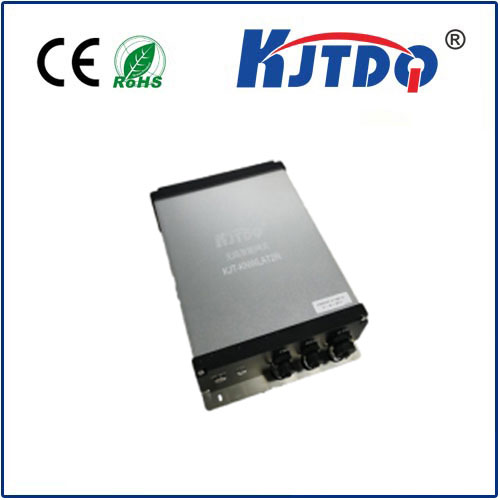
A digital fiber optic sensor amplifier is the electronic half of a fiber-optic sensor: it generates the light, sends it down a flexible fiber to a small passive sensing head, receives the returning light and turns changes in that light into a clean switching signal. Because the head contains no electronics, it can reach very small targets and tight, hot or awkward spots that a standard photoelectric sensor body cannot. KJT Sensors offers fiber-optic sensors and amplifiers for small-target detection, narrow mounting spaces, colour-difference checks and installations where the electronics must sit away from the detection point.


Figure 1. KJT Sensors digital fiber-optic sensor amplifier for industrial automation.
It handles every electronic task, so the fiber and head only carry and shape light. Inside the amplifier, a light source produces the detection beam, which travels through the fiber to the sensing head placed next to the target. Light that is reflected back, or that passes across a gap to a second fiber, returns to the amplifier, where a receiver converts it into an electrical value. The amplifier strengthens and processes this signal, compares the light level with a threshold and switches its output when the target appears, moves, changes colour or alters the surface condition.
A digital amplifier shows the received light level as a number and lets the threshold be taught or adjusted from its keys, which makes setup repeatable and quick when products or fiber heads are changed.
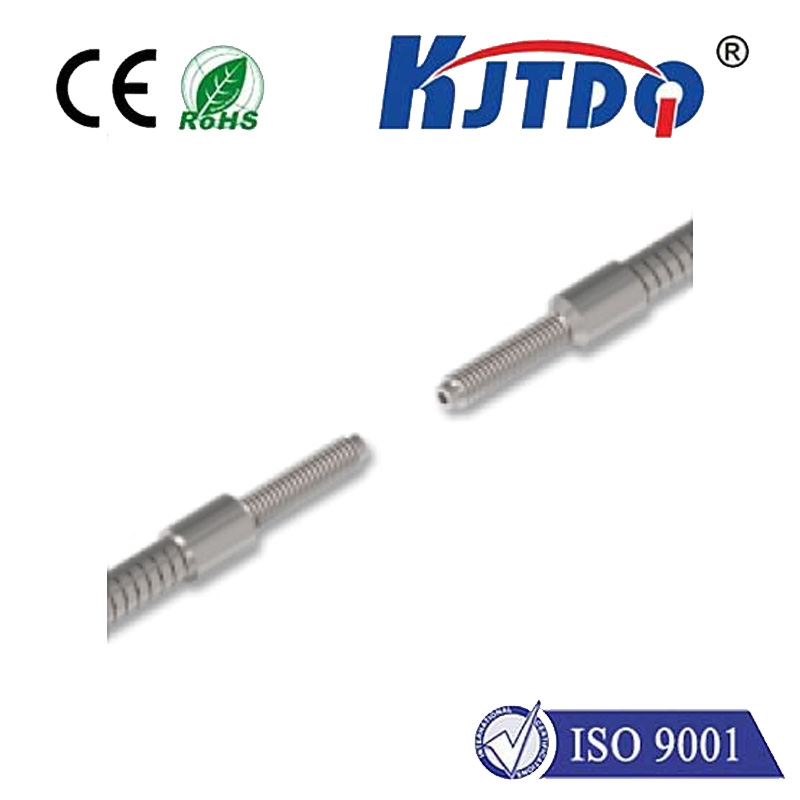
Separating them puts the bulky, heat-sensitive part in a protected place and leaves only optics at the point of detection. Fiber heads are tiny and contain no electronic components, so they fit into gaps where a standard sensor body cannot. The fiber itself can be routed around corners and through moving assemblies, and because it carries light rather than current it is not affected by electromagnetic interference. This is why fiber-optic sensing is favoured in electronics assembly, packaging, precision assembly and compact automated equipment.
| Arrangement | Where the electronics sit | Typical reason to use it |
|---|---|---|
| Integrated photoelectric sensor | In the sensor body at the detection point | Enough space, normal conditions |
| Fiber head with digital amplifier | In a cabinet or on a rail away from the target | Tiny targets, narrow gaps, heat or moving parts near the target |
A wafer-handling robot in a cleanroom is a good illustration. The robot wrist must confirm that a wafer is present on the end effector, but there is very little room there and every component added to the arm adds weight and another item to keep clean. With a fiber-optic system, the amplifier is mounted in a remote cabinet, and a flexible fiber is routed along the arm into the wrist, ending in a small sensing head near the wafer. The arm carries only passive optics, while all electronics, adjustment keys and the display stay in the cabinet where they are easy to reach. The fiber chosen for such a route needs to tolerate repeated bending as the arm moves.
The same amplifier family can serve quite different detection jobs, depending mainly on the fiber head fitted to it:
presence detection of very small parts, such as electronic components or fine wires;
position changes of small mechanisms inside compact equipment;
colour or contrast differences on parts and packaging;
changes in surface condition, such as the presence or absence of a film or coating;
detection near hot zones, where only the fiber head is exposed to the heat.
Fiber sensors are one of several photoelectric variants alongside standard, background-suppression, slot, label, colour-mark, laser and time-of-flight types. Where a dedicated colour-mark sensor is needed for registration on printed material, that product may suit the job better.
Begin with the target: its size, surface and how fast it passes. Then choose the head style, such as diffuse (one fiber pair looking at the target) or through-beam (light sent across a gap), and plan the fiber route, including bending at moving joints and how far the amplifier sits from the detection point. Response speed, output type and the range of compatible fiber heads differ between models, and the product datasheet should guide the final pairing.
Does the fiber head need power?
No. The head is purely optical; light source, receiver and signal processing are all in the amplifier.
Can a fiber-optic sensor work near heat?
The passive head and suitable fibers can be placed in hot or tight areas while the amplifier stays in a cooler location, which is one of the main reasons for choosing this arrangement.
Why choose a digital amplifier rather than a simple one?
A digital display of the received light level and teach-in setup make thresholds easier to set, compare and repeat after a changeover.
Is a fiber sensor affected by electrical noise from motors?
The fiber carries light, not electrical signals, so the cable run to the head is immune to electromagnetic interference.