check

check

check

check

check

check

check

check

check

check
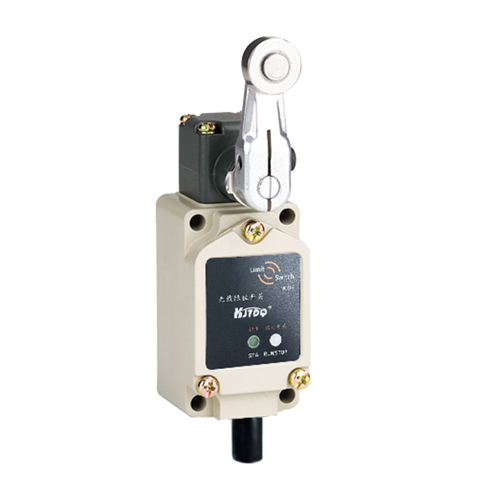
A wireless limit switch is a mechanical position switch that reports its state by radio instead of through a cable. A moving machine part still presses its roller lever, plunger or rod, the internal contacts still change over, but the resulting on or off state is transmitted wirelessly to the host system. KJT Sensors offers wireless limit switches for carts, rotating assemblies and remote equipment where running a signal cable to the switch is awkward, so position feedback can reach the controller without a trailing cable.


Figure 1. KJT Sensors wireless limit switch for remote machine position feedback.
It works exactly like a conventional limit switch at the point of actuation; only the signal path changes. When a carriage, door or arm reaches its end position, it physically pushes the actuator. That movement operates the contacts inside the switch, turning a mechanical displacement into an electrical change of state. In a wired switch, that change travels down a cable. In a wireless switch, a small transmitter inside the housing sends the new state to a receiver at the control system. The switch therefore keeps the familiar strengths of a mechanical device: a clear, physical confirmation that the part has arrived, and an actuator that can be checked by hand.
The cable is often the weakest part of a position check on moving equipment. A switch fitted to a shuttle, a turntable or a travelling cart needs its signal brought back to a fixed controller, which usually means a cable chain, slip ring or long flexible lead. Those add cost and take up space, and they flex with every cycle. Sending the contact state by radio simplifies that feedback path on moving or remote machinery. It also helps where a switch sits far from the control cabinet and running conduit would be disproportionate to the job.
Take a mobile transfer cart that shuttles parts between workstations. Each station needs to know the cart has stopped in the right place before loading starts. A wireless switch on the cart, pressed by a fixed cam at each station, can relay that position to the main line controller without an umbilical cable following the cart along its track.
Almost everything except the signal route. It remains a contact device with moving parts, so its actuator and contacts wear with use and must be chosen for the number of operations and the environment. Its basic role is unchanged too: to limit and protect the travel of machinery. When the moving part reaches a preset end point, the switch prompts a stop or a changeover, which keeps rollers, wheels and slides from running past their limits and being damaged. Because the trigger is mechanical, it is also a sensible choice where dust or electromagnetic interference would make some electronic sensors less dependable in harsh operating conditions. Automatic position feedback of this kind also reduces the risk of damage to components and cuts down on manual checks, visual inspection and hand starting and stopping of equipment.
It pays off where moving parts or distance make cabling difficult. Typical locations include:
travelling carts and shuttles on assembly and logistics lines;
rotating tables, swing arms and other equipment that would otherwise need slip rings;
lifting platforms and storage equipment with long travel;
conveyor ends and remote positions far from the control cabinet.
On fixed machines with short, protected cable runs, a conventional wired switch remains the simpler option.
| Switch type | What it adds | Where it is chosen |
|---|---|---|
| Wireless limit switch | Radio signal path, no trailing cable | Moving carts, rotating or remote equipment |
| Heavy-duty limit switch | Reinforced housing and actuator for impact | Cranes, conveyors, heavy machines |
| Waterproof limit switch | Sealed actuator housing against moisture | Washdown zones, outdoor equipment |
| Micro limit switch | Compact snap-action contacts | Small mechanisms with little mounting room |
All four share the same principle: a moving part physically operates the switch.
Is a wireless limit switch a sensor that works without touching the target?
No. The target must still press the actuator. Only the signal that reports the contact state is sent wirelessly.
Does the wireless version wear like a standard limit switch?
Yes. Its lever or plunger and its internal contacts move with every operation, so mechanical life should be checked on the datasheet.
What equipment benefits most from going wireless?
Moving or remote equipment, such as transfer carts, turntables and long-travel platforms, where a signal cable would have to follow the motion.
What should be reviewed before choosing a model?
Confirm the actuator style, the environment and the radio path between switch and receiver against the product datasheet, ideally with an application review.