check
check
check
check
check
check
A limit switch confirms machine travel by mechanical contact: a moving component physically actuates the switch, giving an unambiguous switching action that tolerates dust, oil and electromagnetic interference but wears over time and needs overtravel allowance. A proximity sensor confirms position without contact — inductive for metal targets, capacitive for other materials — eliminating wear but introducing sensing-distance dependence on target size, material and surroundings. Choose the limit switch when the motion reliably makes contact and the circuit needs a simple, interference-immune signal; choose proximity sensing when contact is undesirable, speeds are high, or actuation cycles are very frequent. KJT Sensors manufactures both families — including the KJT-LXK3 travel switch series rated up to AC 380 V / DC 220 V — so the choice can follow the application, not the catalogue.
The core trade is contact versus wear: a limit switch's contacts and actuator are consumed by every actuation; a proximity sensor's sensing face is not touched at all.
Limit switches win on interference immunity: purely mechanical triggering means no dependence on electronic chips, and no influence from electromagnetic interference, voltage fluctuation or signal waves (manufacturer-stated).
Proximity sensors win on speed and cycle life: non-contact operation suits high actuation frequencies and fast-moving mechanisms where mechanical actuation cannot keep up or wears out.
Target material decides proximity type: inductive sensors detect metal; capacitive sensors extend to non-metals and liquids. Limit switches do not care what the target is made of — only that it can press, roll or cam the actuator.
Overtravel is a limit-switch design input: the mechanism must be able to travel past the trip point without breaking the actuator; proximity sensing has no equivalent mechanical constraint.
Both families are available from KJT Sensors in environment-specific versions — high-temperature, waterproof, dual-circuit, explosion-proof limit switches; and multiple inductive/capacitive proximity series.
A limit switch (also called a travel switch or position switch) is a low-current control device in which a moving machine component mechanically actuates the contacts to make or break a control circuit. KJT Sensors' travel-limit products use this mechanical actuation to produce "an unambiguous switching action" for position determination, end-of-travel limiting, mechanical interlocking and safety protection, with applications covering automatic stopping, reversing, speed changing and automatic reciprocating control (manufacturer-stated, Limit Switch Sensor).
The KJT-LXK3 series is designed for control and auxiliary circuits at 50–60 Hz AC up to 380 V or DC up to 220 V, for operation, control, signaling and interlocking duties (manufacturer-stated). The product line spans standard, waterproof, double-circuit, high-temperature, heavy-duty, explosion-proof, stainless-steel, micro, wireless and high-temperature micro limit switch series — confirmed as live product series on the category page.
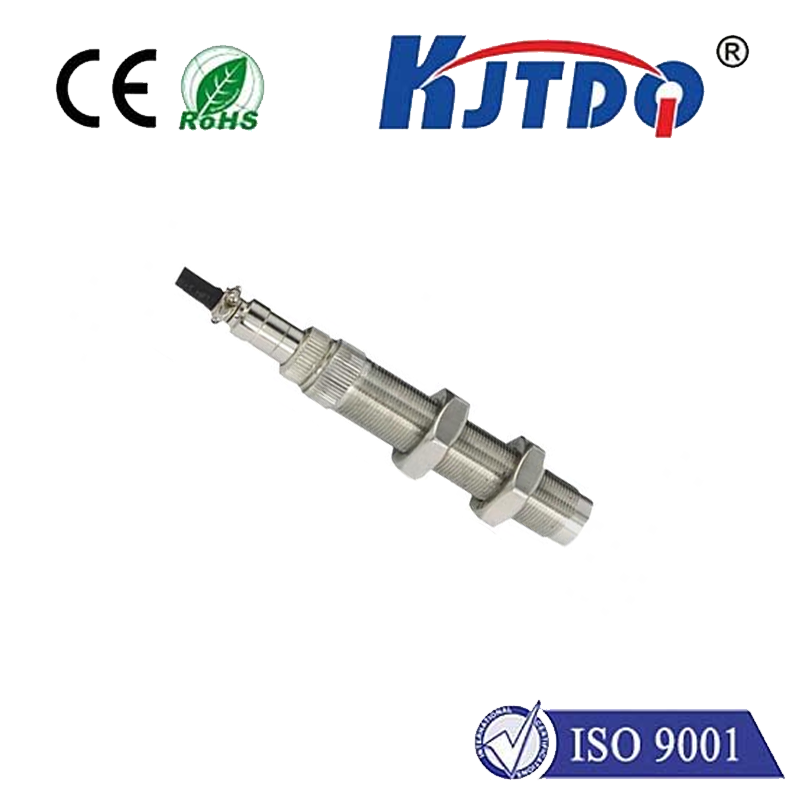
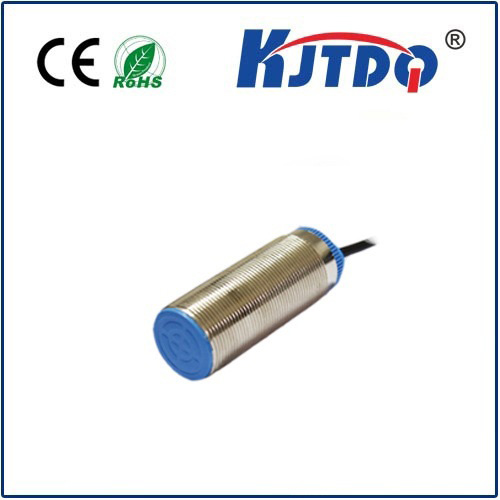
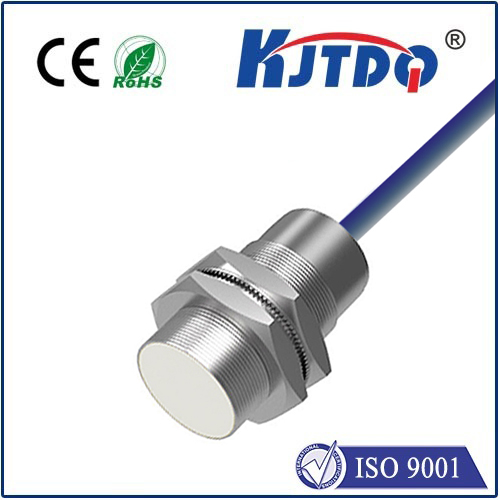
A proximity sensor detects the presence of a target within its sensing distance without physical contact. Inductive types generate an electromagnetic field and detect the eddy-current disturbance a metal target introduces; capacitive types detect the capacitance change any material — plastic, liquid, granulate — produces near the sensing face. KJT Sensors' proximity portfolio spans more than a dozen inductive series (including high-temperature, NAMUR and weld-field-resistant variants) plus capacitive series capable of detecting non-metals and liquids through container walls (manufacturer-stated, Proximity Sensors).
For travel detection, the practical consequence is that the sensor must be placed at a defined sensing distance from a target — a metal flag, a machine part, a cam — and the effective distance shifts with target size, material and surrounding metal. Those dependencies and the inductive/capacitive choice are covered in depth in the inductive-versus-capacitive proximity comparison ({{URL_F02}}).
| Dimension | Limit switch (mechanical) | Proximity sensor (non-contact) |
|---|---|---|
| Actuation principle | Physical contact: plunger, roller lever, or cam presses the actuator | Field-based: inductive (metal) or capacitive (most materials) detects target presence |
| Wear and life | Contacts and actuator wear with every cycle; mechanical life is a rated quantity; some KJT models rated for over one million operations (manufacturer-stated) | No mechanical wear at the sensing face; life limited by electronics and environment |
| Repeatability of trip point | Set by mechanics; stable but subject to actuator wear over time | Set by sensing distance; depends on target size, material, temperature and nearby metal |
| Speed of response | Mechanical snap action — fast, but limited by actuator travel and mechanism inertia | Electronic switching — typically higher switching frequency; suits fast cycles |
| Interference immunity | Excellent: no electronic dependence in the sensing element; immune to EMI, voltage fluctuation | Electronics present; models add protection, but strong fields and nearby metal must be considered |
| Target material requirement | None — anything that can mechanically actuate the head | Inductive: metal required; capacitive: nearly any material, with distance varying by material |
| Overtravel requirement | Mechanism must travel past trip point within the actuator's overtravel capacity | No overtravel concept; target simply passes through the sensing field |
| Environmental versions (KJT Sensors) | High-temperature, waterproof, dual-circuit, explosion-proof, stainless-steel, heavy-duty series | High-temperature, NAMUR, weld-field-resistant inductive series; capacitive with compensation options |
| Typical failure mode | Contact wear, chatter, actuator damage from overtravel or impact | Distance drift from target change, false triggering from surrounding metal, contamination on face |
| Circuit integration | NO/NC contact configurations directly in control circuits, up to AC 380 V / DC 220 V (KJT-LXK3) | NPN/PNP, NO/NC switching outputs to PLC inputs at sensor-level voltages |