

check

check

check

check

check

check

check

check

check

check
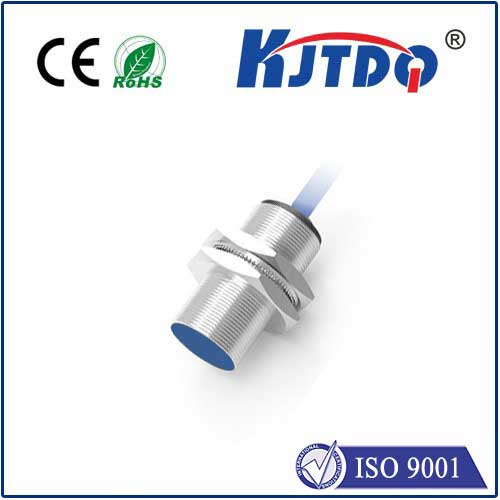
An all-metal inductive proximity sensor is a proximity switch whose housing and sensing face are both made of stainless steel, so the front of the sensor can take knocks and abrasion that would crack a plastic face. It still detects metal targets without touching them: the sensor reacts to a metal object entering its electromagnetic field. KJT Sensors supplies these stainless versions for machines where parts, chips or tooling regularly strike or rub against the sensing area, such as presses, stamping dies and heavy handling equipment.

Figure 1. KJT Sensors all-metal inductive proximity sensor with stainless steel housing and sensing face.
On a standard inductive sensor the threaded body may be metal, but the active face is usually a plastic cap. On an all-metal design the face itself is stainless steel, closed and flush with the housing. That changes how the sensor behaves mechanically, not what it detects. The stainless face is engineered to withstand mechanical impact and abrasive contact, so a blank that slides across it, a scrap edge that hits it or metal grit that scours it is far less likely to damage the front of the device. In daily use the sensor does exactly what any inductive proximity switch does: confirm position, in-position status and motion of metal objects.
It uses electromagnetic induction. An oscillator inside the sensor generates an alternating magnetic field in front of the face. When a metal target moves into that field, eddy currents are induced in the metal, which draw energy from the oscillator and change its amplitude. The electronics register this change and turn it into a switching signal. The design of an all-metal sensor accounts for the stainless face so that the field still projects outward to the target. Because the detection is entirely electromagnetic, the target never has to touch the sensor, and only metal objects produce a response; plastic, wood or cardboard will not trigger it.
It pays off wherever contact with the sensing face is likely even though the sensing itself is contactless. Automotive stamping is a typical case. When a die ejects a finished part, sharp steel blanks can strike the area around the die and repeatedly hit a sensor that is checking for part presence. A plastic face tends to chip or wear through under that treatment, whereas a stainless face is built to survive it. Similar conditions appear in:
press lines and transfer systems handling stamped or punched parts;
welding and assembly fixtures where hot spatter and metal debris reach the sensor;
conveyors and chutes carrying metal parts that slide past or bounce against the sensor;
machines cleaned with abrasive methods that would scuff a plastic cap.
In all of these, the job is still plain metal detection for presence checks, counting, end-of-travel confirmation and equipment status monitoring.
The stainless housing answers a mechanical problem, so it is not automatically the right pick everywhere. If parts are very small, such as screws, pins, rivets or small stampings dropping through a feed, a ring inductive sensor that detects objects passing through its central opening may suit the task better. If space is tight inside a fixture, a miniature inductive sensor fits more easily. If the target is not metal at all, an inductive sensor is the wrong technology; a capacitive proximity sensor detects plastics, glass, wood, liquids, powders and granules, and is often used for level or presence checks behind a non-metallic wall.
| Situation | Usual sensor choice |
|---|---|
| Metal target, frequent impact or abrasion at the face | All-metal stainless inductive sensor |
| Small metal parts falling through a feed | Ring inductive sensor |
| Metal target in a cramped fixture | Miniature inductive sensor |
| Non-metallic material, liquid or powder | Capacitive proximity sensor |
A mechanical switch needs the part to push an actuator, and in a stamping or handling area that actuator takes the same punishment as the sensor face, with every cycle. An inductive sensor does not rely on direct contact movement, so it suits processes with frequent switching, long running hours and harsh surroundings. The stainless body adds resistance to the knocks that do happen, which is the combination these machines need.
Sensing range, housing size and output type differ between models, and a stainless face can affect how far the sensor reaches, so check the datasheet of the specific sensor against the target material and mounting position.
Does a stainless sensing face mean the part may touch the sensor on purpose?
No. Detection is still contactless; the steel face simply tolerates the accidental impacts and abrasion that occur on presses and handling equipment.
Will an all-metal inductive sensor detect plastic parts?
No. Like every inductive sensor it responds to metal only. Plastic, glass, liquids or powders call for a capacitive sensor instead.
Is an all-metal sensor useful on a stamping die?
Yes, it is a common choice where ejected steel blanks would otherwise strike and wear a plastic sensing face during part-presence checks.
Can it count parts as well as confirm position?
Yes. Counting metal parts, checking presence and confirming end of travel are all standard uses of inductive proximity switches.
Inductive vs Capacitive Proximity Sensors: Which Should You Use?
Why Does a Proximity Sensor Detect the Machine Frame or Miss the Target?