check
check
check
check
check
check
An OEM requesting a custom industrial sensor should specify six groups of information: the application brief (machine, target, distance, speed, environment), the sensing requirements, the mechanical specification (housing, thread, bracket, cable outlet, connector), the electrical specification (output, supply, wiring), the commercial and quality requirements (quantity, MOQ, documentation, certifications), and the validation plan (sample tests and acceptance criteria). KJT Sensors' published customization process asks for exactly this structure — application analysis, technical evaluation, a proposal covering specifications, samples, testing, MOQ and documentation, then sample development and controlled production — and supports modified standard products, OEM projects and application-specific development.
Specify the application first, the part number never. A custom sensor starts from the machine, target, distance, space, environment, output, cable, quantity and timeline — the inputs KJT Sensors' process lists for application analysis.
Four specification domains define the product. Mechanical (housing, thread, connector, cable outlet), electrical (NPN/PNP, analog, RS485, IO-Link), sensing performance (distance, range, target, response), and environmental protection (temperature, water, oil, dust, corrosion, vibration).
A specification without acceptance criteria is not a specification. KJT Sensors' process includes sample development and testing against agreed requirements before batch production.
Commercial and lifecycle terms belong in the request. Quantity, MOQ, documentation needs, private labeling and long-term supply support are part of KJT Sensors' published OEM/ODM scope.
Small batches are a supported path. KJT Sensors states projects can begin with sample development and continue into small-batch or long-term production.
The quality of a customization outcome is set by the quality of the request: an incomplete brief produces a generic proposal, a complete brief produces a technical one.
A sensor supplier can only engineer against what it is told. If the request says "a photoelectric sensor, smaller," the supplier must guess what "smaller" must fit, what the target actually is, and what environment will kill the product in year two. If the request specifies the machine, the target and its behavior, the installation space, the environment and the electrical interface — the supplier's engineering effort goes into the actual problem. KJT Sensors' own customization page frames its process this way: it starts from the actual application and evaluates overall technical requirements before any product decision, supporting modified standard products, OEM projects and application-specific solutions.
The OEM/ODM technical requirement checklist in this article (see below) is the deliverable that makes this concrete: a structured request a supplier's engineering team can act on, and a baseline against which samples are later judged.
KJT Sensors' application-analysis step lists: machine, target, distance, space, environment, output, cable, quantity and timeline. Concretely: what the machine does, what the sensor must detect or measure (material, size, color, transparency, surface), at what distance and speed, in what installation space and orientation, under which environmental conditions, connecting to what, in what quantity, and needed when. A photograph of the installation point and a machine drawing or sketch convert ambiguity into engineering input — KJT Sensors' service documentation asks for installation photos and machine information in its application consultation and model-replacement processes.
The detection or measurement task stated in engineering terms: sensing distance or measuring range, target definition (material, minimum size, surface, speed), required response behavior (switching frequency, response time, update rate), and the distinction between functions that are essential and functions that are merely desired. For measurement tasks, accuracy, repeatability and resolution must be separated and specified individually — they are not interchangeable terms, and conflating them in a request produces a mis-scoped proposal.
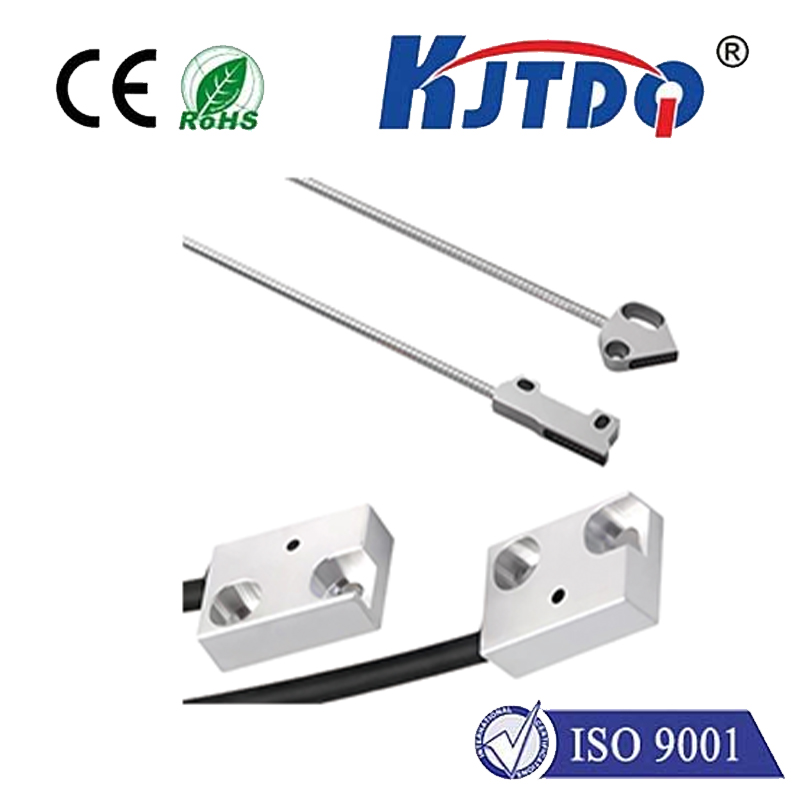
KJT Sensors' published customization capabilities cover the mechanical domain explicitly: housing size and shape, thread and mounting method, sensing-surface configuration, cable outlet direction, connector type and position, bracket or flange design, housing and sealing materials, and compact installation solutions. The request should give: the maximum envelope the machine allows, the mounting interface (thread size, holes, bracket pattern), the cable exit direction the machine's cable routing requires, and the connector standard in use (M8, M12, or custom). Where installation space is the constraint, say so with dimensions — KJT Sensors lists compact installation solutions among its customization scope.
From KJT Sensors' customization page: NPN, PNP, analog, RS485, IO-Link, wiring, cable and connector options. The request fixes: the output type the machine's controller consumes, the supply voltage available, the switching logic (normally open/normally closed), pin assignment where a standard connector is used, and the cable specification (length, jacket material for the environment, shield requirements). If the machine documentation already specifies a connector standard and pinout, include it verbatim — the sensor-PLC integration article explains why output/input matching is checked before anything is wired.
KJT Sensors lists temperature, water, oil, dust, corrosion, vibration and impact resistance among its environmental customization scope. State the real environment, not the catalog one: minimum and maximum ambient temperature, washdown or oil exposure, dust and fiber burden, corrosive agents, vibration and shock levels, and any ingress-protection requirement (IP rating) the machine standard demands. Compliance requirements follow: which certifications must exist for the exact model, and which documents the OEM needs — KJT Sensors' service scope includes product specifications, wiring information, available compliance documents, photos, drawings, test data and inspection records according to project requirements. Certification claims for a custom model are verified against the actual model documents, never assumed from a series family.
The remaining request items: expected annual quantity and batch sizes, the MOQ the supplier quotes (KJT Sensors' proposal step includes MOQ and documentation explicitly), private-labeling requirements if any (KJT Sensors supports private labeling with technical communication, project documentation and long-term supply support, manufacturer-stated), sample lead-time expectations, change-control expectations during development, and the long-term supply horizon — the last-time-buy and continuity terms that matter when a custom sensor goes into a machine platform with a multi-year production life.