check

check

check

check

check

check
<!-- x-tinymce/html -->
Laser, radar and ultrasonic sensors all measure distance without contact, but they answer different application conditions. Laser sensors deliver the highest precision and small measurement spots, within a defined optical range. Radar sensors tolerate dust, fog, rain and darkness and can track moving targets. Ultrasonic sensors are unaffected by target color or transparency and suit short-to-medium ranges at moderate speed. Choose by target surface, environment, range and required accuracy — in that order.
The target decides first. Surface reflectivity, color, transparency and material rule technologies in or out before range is even discussed.
The environment decides second. Dust, fog, rain, steam and strong ambient light degrade optical and acoustic technologies very differently from microwave radar.
Precision and robustness pull in opposite directions. Laser offers millimeter-class resolution; radar and ultrasonic trade some precision for environmental tolerance.
Every technology has a dead zone and a speed limit. Blind zone, response time and update rate must be checked against the actual target motion.
Level measurement is a separate decision. Silo and tank level selection has its own dedicated comparison; this article covers distance measurement on solid targets and positioning tasks.
Laser distance sensors emit a focused light beam and measure the reflection — by time of flight, phase shift or triangulation, depending on the design. The tight beam produces a small measurement spot, so laser sensors achieve high resolution and repeatability at moderate to long ranges. The trade-off is optical: performance depends on how much light the target returns, and airborne dust, steam or heavy ambient light consumes signal margin.
Radar sensors emit microwave signals and evaluate the reflected echo. Microwaves pass through dust, fog and rain largely unaffected, and radar is indifferent to target color and ambient light. Many radar sensors also measure target speed directly from the frequency shift of the echo, which makes them naturally suited to moving-target and collision-warning tasks. The trade-offs are a wider beam — nearby structures can produce unwanted reflections — and lower fine-resolution than laser at short range.
Ultrasonic sensors emit an acoustic pulse above 20 kHz and calculate distance from the echo's round-trip time. Sound reflects well from almost any surface regardless of color, gloss or transparency, which makes ultrasonic a practical choice for clear films, glass, liquids and dark targets at short-to-medium distances. The trade-offs are physics-bound: the speed of sound limits response time, every sensor has a near-field blind zone where it cannot measure, and temperature gradients, strong air currents, foam and heavy vapor degrade the echo.

This matrix is the working tool of the article. It compares the three technologies on the dimensions that drive real selection decisions; model-specific figures belong to data sheets, not to a technology comparison.
| Decision dimension | Laser | Radar | Ultrasonic |
|---|---|---|---|
| Measured signal | Light reflection (ToF / phase / triangulation) | Microwave echo | Acoustic echo (>20 kHz) |
| Typical industrial range class | Medium to very long — KJT Sensors' TLS laser family is published in range classes from 1 m up to 200 m | Medium — KJT Sensors' mini radar is published up to 20 m; radar level designs go further | Short to medium — KJT Sensors' U18/U30 models span 50 mm to 6,000 mm |
| Dependence on target color/gloss | Moderate — dark or glossy targets reduce returned light (reduced in modern designs) | None | None |
| Transparent targets | Difficult (beam passes through) | Possible — depends on material's microwave reflectivity | Good — sound reflects from clear surfaces |
| Dust / fog / rain tolerance | Low to moderate | High — the primary reason to choose radar | Moderate — heavy vapor and foam degrade echoes |
| Ambient light | Can saturate receivers; immune designs exist | Immune | Immune |
| Fine resolution / repeatability | Highest of the three — the published TLS-30C specification lists 1 mm resolution | Lower at short range; strong for speed measurement | Moderate; limited by acoustic wavelength and air conditions |
| Response / update speed | Fast — TLS-30C lists output time from ≥4 ms | Fast — KJT radar pages state millisecond-level response | Slowest of the three (speed of sound) |
| Near-field blind zone | Small | Small | Significant — must be engineered around |
| Beam width / alignment | Narrow spot; precise aiming needed on small targets | Wider beam; watch for structure reflections | Conical beam; target angle and surrounding surfaces matter |
| Temperature influence | Minimal on the measurement itself | Minimal | Direct — sound speed changes with air temperature; temperature compensation is standard practice |
| Best-fit situations | Precision positioning, long-range measurement, small targets, crane/AGV ranging | Dusty or outdoor yards, moving-target tracking, collision warning, harsh-environment level | Transparent or dark targets, short-range presence/distance, tank and level tasks in calm air |
Published KJT Sensors figures above are manufacturer-stated page values verified 2026-10-09; they describe families and specific models as cited, and are not a guarantee for any other model.
Work through these questions in order; stop when only one technology remains standing.
Step 1 — What is the target? Note the material, color, surface (matte or mirror), transparency and size. Mirror-glossy or very dark surfaces stress laser sensors; soft sound-absorbing surfaces (foam, fine powders at steep angles) stress ultrasonic; materials with very low microwave reflectivity stress radar. If the target is small or you must measure a precise point, the laser's small spot is a structural advantage.
Step 2 — What is the environment? This is where radar earns its place. Dust clouds, fog, rain, steam and outdoor darkness are microwave-transparent but optically and acoustically hostile. KJT Sensors positions its radar family for exactly these conditions, with published IP67/IP68 protection and operation down to −20 °C. Indoors in clean air, laser and ultrasonic compete on merit.
Step 3 — What range and accuracy do you actually need? State the measuring range and the required repeatability, not a vague "as accurate as possible." If you need millimeter-class resolution, the published TLS-30C specification (1 mm resolution; accuracy 1.5 mm + 0.5‰ of distance) shows what laser technology delivers. If you need 50–100 m or more, laser range classes up to 200 m are published in the TLS family. If you need robust tens-of-meters detection in bad air rather than precision, radar's published 20 m mini-radar class is the realistic starting point.
Step 4 — How fast is the target or the process? For moving targets, the sensor's response time and output rate must be short compared with the time the target spends in the measurement zone. Laser (TLS-30C: output time ≥4 ms, adjustable measurement frequency) and radar (millisecond-level response, manufacturer-stated) serve fast applications; ultrasonic is the slowest and suits slower level and positioning tasks. Radar additionally measures target speed directly. For a full treatment of range, response, repeatability and interface selection on moving targets, see the dedicated moving-target distance-sensor guide.
Step 5 — What does the controller need? Confirm the output before finalizing the model. The TLS-30C, for example, publishes PNP/NPN switching, 0–10 V / 4–20 mA analog and RS-485 Modbus RTU on one device; KJT radar models offer adjustment via IO-Link. Output availability is model-specific — verify it on the exact model's page, and treat the interface comparison as its own decision.
Long range changes the question from "which technology measures farthest" to "which technology keeps enough signal margin at that distance." Three effects dominate:
Signal loss grows with distance. Optical returned energy falls steeply with range and target reflectivity; acoustic energy spreads and attenuates even faster, which is why ultrasonic is rarely a long-range answer. Microwave radar holds up better in open air.
Beam geometry becomes the constraint. At 50 m and beyond, a wide beam illuminates structures around the target. The laser's narrow spot (the TLS-30C publishes a 15 × 15 mm spot at 10 m) keeps the measurement on the target; radar's wider beam demands a clear field of view.
Alignment and stability are installation problems. Long ranges amplify mounting vibration and angular error. Rigid brackets, stable aiming and — for optical devices — protection from direct sunlight into the receiver are standard practice.
Within KJT Sensors' published range, the TLS laser family offers range classes up to 200 m for clean-air, line-of-sight measurement, while radar covers long detection where dust, fog or darkness would defeat optics. Confirm the achievable range for the exact model and target reflectivity by sample test.
Four adjacent questions are deliberately not answered in depth here because each has its own owner:
Silo, tank and outdoor level applications (S21/S20). Level selection weighs vapor, foam, dielectric properties and vessel geometry differently. See the radar-vs-ultrasonic level comparison
Navigating all measuring variables (S68/S69). Distance, displacement, level, flow and inclination each have their own technology map; the KJT Sensors measuring-sensor category page is the navigation hub.
Eddy-current displacement (part of S67). For conductive metal targets at short range with very high resolution — shaft vibration, axial position — eddy-current sensors are a fourth technology. See the eddy-current vs laser displacement comparison.
Laser distance vs laser displacement vs LiDAR (E06). Laser distance sensors measure absolute distance to a point; laser displacement sensors measure fine position change; LiDAR scans areas for navigation and zone monitoring. The taxonomy is covered in.
Crane anti-collision is an application decision with its own safety and environment constraints; see.
All three technologies are covered in KJT Sensors' published range (verified 2026-10-09):
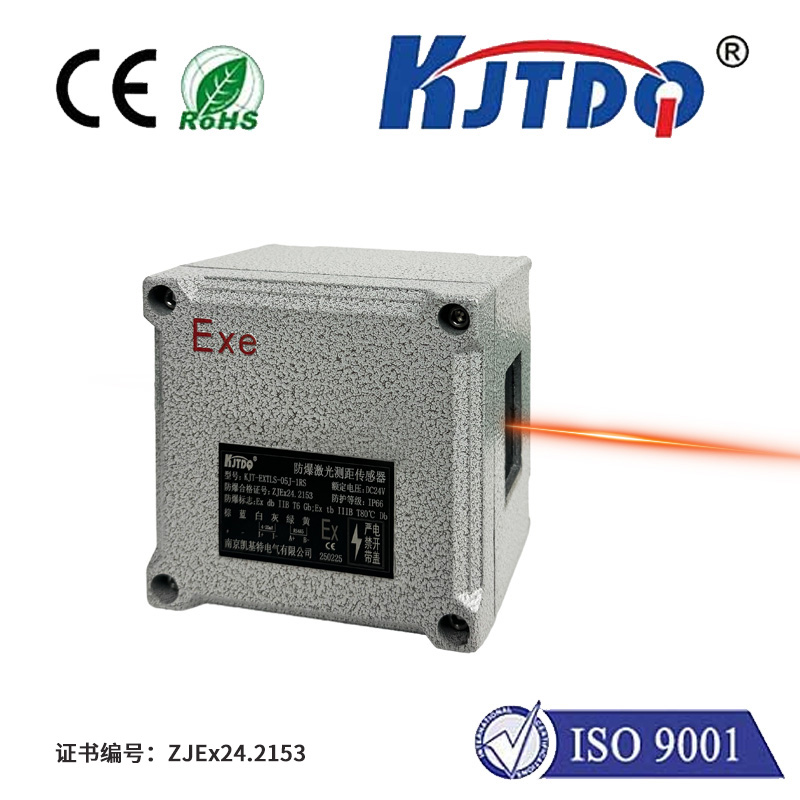
Laser: the laser ranging sensor family publishes TLS high-frequency laser ranging displacement sensors in range classes from 1 m to 200 m. The TLS-30C model page publishes 1 mm resolution, accuracy of 1.5 mm + 0.5‰ of distance, output time from ≥4 ms, PNP/NPN + analog + RS-485 Modbus outputs, a five-digit display with push-button teach, laser class 1 (IEC 60825-1) and an industrial enclosure — verify the protection rating on the exact model's specification table.
Radar: the radar sensor family publishes mini-radar designs with narrow beam angle, range up to 20 m, millisecond-level response, IO-Link adjustment, IP67/IP68 protection and operation down to −20 °C; KJT documentation references 24 GHz, 80 GHz and 125 GHz bands across the radar range, plus radar level transmitters and collision-avoidance radar.
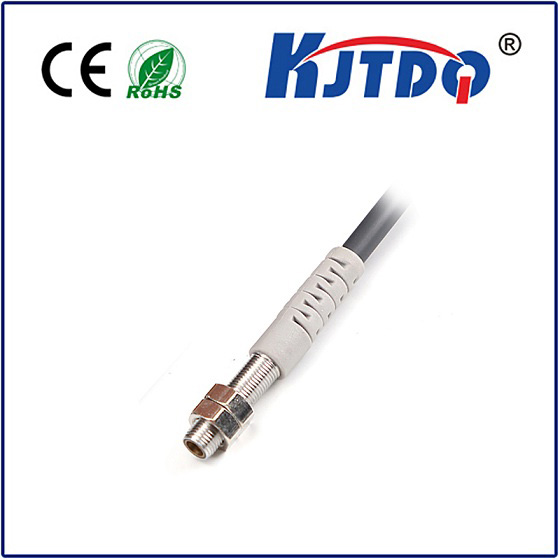
Ultrasonic: the ultrasonic sensor family publishes U18 and U30 series models from 50 mm to 6,000 mm, including double-sheet-detection variants, for distance, presence and level tasks.
Browse the complete measurement portfolio on the measuring-sensor category page or the product center.
All published figures quoted here are manufacturer-stated and model-specific; they describe the cited families and models only. Measuring range, accuracy, repeatability and response must be confirmed on the data sheet of the exact model — and, for critical applications, by sample test on the real target.
Laser sensors are unsuitable where heavy dust, steam or dense fog permanently fills the measurement path; radar is unsuitable where fine millimeter-class resolution at short range is the primary requirement; ultrasonic is unsuitable in strong air currents, heavy vapor or where the blind zone cannot be accommodated.
This article covers distance measurement on solid targets and positioning tasks. Continuous level measurement in vessels, precision displacement on metal targets and area-scanning (LiDAR) are separate decisions with their own guides, linked above.
Safety-related distance functions (personnel protection, safety-rated collision avoidance) require safety-rated devices and model-level certification, which are outside the scope of this comparison.
Which distance sensor works in dust or fog? Radar is the standard choice: microwave signals pass through dust, fog and rain with little attenuation, and radar is indifferent to ambient light and target color. Laser sensors lose signal margin as airborne particles scatter the beam; ultrasonic echoes degrade in heavy vapor. KJT Sensors positions its radar family for harsh environments with published IP67/IP68 protection.
Which target properties must I supply before a distance technology can be selected? Material, color, surface finish (matte or mirror), transparency, size and — for moving targets — speed and direction of travel. Add the required measuring range, the required repeatability, the environment (dust, vapor, temperature, ambient light) and the mounting position. These inputs decide the technology before any model is discussed.
When does an ultrasonic blind zone matter? Whenever the target can come closer to the sensor face than the blind-zone distance, the sensor cannot measure it reliably. In level applications this means mounting the sensor high enough that the maximum fill level stays outside the blind zone; in positioning tasks it means respecting a minimum standoff. The blind-zone value is model-specific — confirm it on the data sheet.
Can a laser sensor measure a dark or glossy target? Modern laser distance sensors are designed to reduce the influence of target color, material and gloss — the TLS family states detection of vertical or tilted targets regardless of color, material or gloss — but very dark or mirror-like surfaces still reduce returned light and effective range. For critical cases, request a sample test on the actual target.
Which technology is best for a fast-moving target? Laser and radar both serve fast applications: the TLS-30C publishes output time from ≥4 ms, and KJT radar pages state millisecond-level response. Radar also measures speed directly from the echo. Ultrasonic is the slowest of the three and suits slower processes. The moving-target selection guide works through response, repeatability and interface requirements in full.
Is radar affected by metal structures near the beam? Yes — radar's wider beam can pick up reflections from frames, walls and agitators, not just the target. Narrow-beam designs (KJT publishes a narrow-beam mini radar) and careful mounting reduce the problem; site structures should be part of the information you send with a selection request.
Laser, radar and ultrasonic are complementary, not competing, answers. Laser wins on precision and small-spot long-range measurement in reasonably clean air; radar wins on environmental robustness and moving-target work; ultrasonic wins on color- and transparency-independent detection at short range. Decide the target first, then the environment, then range and accuracy, then speed — and verify the final model by data sheet and sample test.
Ready to specify a distance sensor? Send KJT Sensors your target properties, range, environment and required output — the application team will recommend a technology and model. Explore the measuring-sensor range or start from the product center.
| # | Source | Type | Used for |
|---|---|---|---|
| 1 | KJT Sensors laser ranging sensor page — https://www.kjt-sensors.com/list-jgcjcgq.html (verified 2026-10-09) | KJT Sensors first-party | TLS family range classes 1 m–200 m; family positioning |
| 2 | KJT Sensors TLS-30C model page — https://www.kjt-sensors.com/show-559.html (verified 2026-10-09) | KJT Sensors first-party | 1 mm resolution; accuracy 1.5 mm + 0.5‰; output time ≥4 ms; 5/10/20/30 Hz; PNP/NPN + 0–10 V/4–20 mA + RS-485 Modbus RTU; five-digit display + teach; laser class 1 (IEC 60825-1); 15×15 mm spot at 10 m; color/material/gloss-independence statement (all manufacturer-stated) |
| 3 | KJT Sensors radar sensor page — https://www.kjt-sensors.com/list-radar_sensors.html (verified 2026-10-09) | KJT Sensors first-party | Mini radar: narrow beam, up to 20 m, millisecond response, IO-Link, IP67/IP68, −20 °C (all manufacturer-stated) |
| 4 | KJT Sensors ultrasonic sensor page — https://www.kjt-sensors.com/list-csbcgq.html (verified 2026-10-09) | KJT Sensors first-party | U18/U30 series 50 mm–6,000 mm; double-sheet-detection variants |
| 5 | KJT Sensors measuring-sensor category page — https://www.kjt-sensors.com/list-clcgq.html (verified 2026-10-09) | KJT Sensors first-party | Measuring portfolio structure (laser/ultrasonic/radar/eddy-current/level/flow/inclination) |
| 6 | KJT Sensors product center — https://www.kjt-sensors.com/list-product.html (verified 2026-10-09) | KJT Sensors first-party | Portfolio navigation |
| 7 | KJT Sensors Laser, Radar and Measuring Category Knowledge Bases (internal, 2026) | KJT Sensors internal documentation | Radar frequency bands (24/80/125 GHz); radar level/collision-avoidance variants; ultrasonic blind-zone/temperature-compensation guidance; application context |