

check

check

check

check

check

check

check

check

check

check
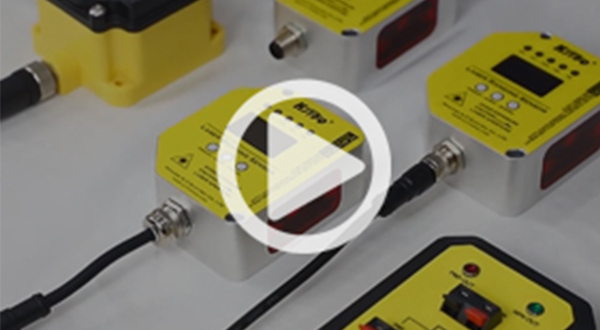
A ToF laser photoelectric sensor confirms that an object is present by timing how long its laser pulse takes to come back, instead of judging only how bright the reflection is. Because the decision rests on measured distance, dark, shiny, curved and even transparent targets are recognised more consistently than with an ordinary photoelectric switch. KJT Sensors supplies this ToF sensor for target presence detection as a non-contact device for automation sites, from packaging and sorting lines to warehouses and outdoor areas.


Figure 1. KJT-FG30 ToF laser photoelectric sensor for industrial presence detection.
The sensor emits a laser beam, receives the light reflected from whatever lies in front of it and calculates the distance from the travel time. A presence decision is then made against that distance: if something sits inside the taught window, the output switches; if the beam only reaches the far background, it does not.
This is a different logic from a conventional diffuse switch, which mainly reacts to the amount of returned light. A matt black box sends back little light and a polished can sends back a lot, so intensity alone can confuse the two. Timing the return makes the result much less dependent on colour, curvature, material and changes in the surroundings.
Targets that give an intensity-based switch a hard time are where ToF earns its place:
dark or low-reflectance parts, such as black plastics and rubber;
glossy or curved surfaces that scatter light unevenly;
transparent bottles, trays and films;
objects in front of a busy or reflective background;
detection across longer gaps or under strong ambient light, including outdoors.
Compared with a photoelectric switch based purely on returned light, a time-of-flight unit is better suited to complex surfaces, see-through objects, long distances and bright environments. It still needs a usable reflection, so the material and finish of the real target should be shown during application review.
It helps to picture the device as a set of functional blocks, each with a clear job:
| Block | What it contributes to presence detection |
|---|---|
| Ranging module | emits the beam, receives the return and calculates distance |
| Photoelectric detection | turns that distance into a present or in-position decision |
| Background suppression | ignores what lies beyond the window and reduces colour, reflectivity and ambient-light effects |
| High-speed response | keeps pace with fast lines and short gaps between items |
| System interface | passes the result to the controller |
| Industrial protection | lets the housing cope with plant conditions |
Seen this way, the sensor is both a short-range distance meter and a presence switch, and the background-suppression block is what keeps a conveyor frame or rear wall from being mistaken for a product.
It fits anywhere the question is "is the item there?" but the items vary or the surroundings are awkward. Common uses include counting on high-speed production lines, checking packs at packaging stations, confirming parcels at logistics sorting points, verifying pallets and totes in smart warehouses, and detecting objects outdoors. The same unit can also report distance and help with positioning, so one sensor may cover both presence and a rough position check.
Compact ToF laser sensors are available for machine frames with little spare room, which suits material handling equipment where a large housing would be in the way.
Both are optical and both work without touching the target, but they answer different questions. A ToF photoelectric sensor mainly decides presence and in-position status, with distance as the basis for that decision. A laser displacement sensor, by contrast, combines laser emission, optical imaging and signal processing to track small changes in a surface's position, and is used to judge thickness, flatness and profile in precision manufacturing. For simply knowing whether a part has arrived, ToF is the more natural pick.
Can a ToF sensor see clear glass or plastic bottles?
It is generally much better at it than an intensity-based switch, because it relies on timing the return rather than its strength. The actual container should still be tested during selection.
Does background suppression mean the conveyor will be ignored?
That is its purpose. Anything beyond the set distance window is treated as background, so the frame or rear wall does not switch the output.
Is a ToF sensor suitable for outdoor detection?
Yes, outdoor detection is one of its typical uses, since timing the light is less affected by strong ambient lighting than measuring its intensity.
Will it give a distance value as well as a presence signal?
It calculates distance internally, and depending on the model that value can support positioning as well as a switching output.