check
check
check
check
check
check
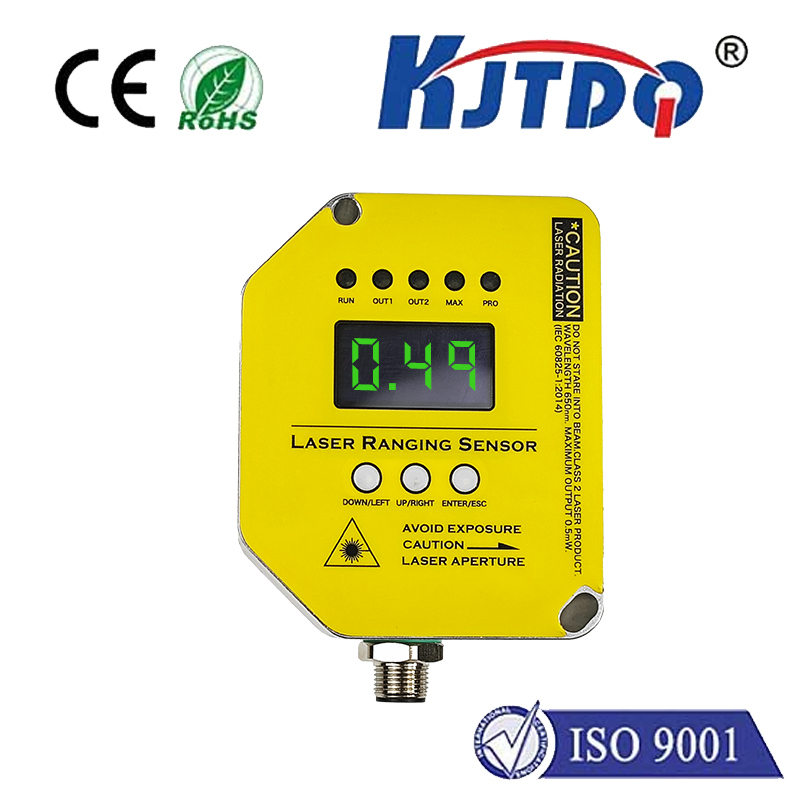
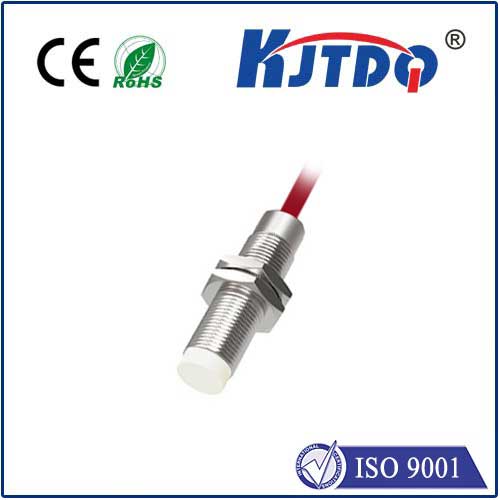
An eddy-current sensor measures the distance to a conductive metal target by sensing how the target disturbs a high-frequency magnetic field — non-contact, short-range, indifferent to oil, dirt, humidity and target surface finish, which makes it the default for shaft vibration, axial position and metal displacement inside machinery. A laser displacement sensor triangulates a light spot off almost any surface — metal, plastic, ceramic — reaching longer standoff distances and finer spot geometry, but its reading depends on the surface returning light: dark, glossy or transparent surfaces destabilize it. Choose eddy-current when the target is metal, the environment is contaminated and the range is millimetres; choose laser when the target is non-metal, the standoff must be larger, or the measurement must resolve small features. KJT Sensors supplies both: eddy-current displacement sensors for conductive targets (high linearity and resolution, static and dynamic) and the TLS laser family including the TLS-30C with 1 mm resolution and ±1.5 mm + 0.5‰ accuracy (manufacturer-stated).
Material is the first gate: eddy-current requires a conductive metal target — it cannot measure plastic, glass or ceramics; laser measures nearly any surface that reflects or diffuses light.
Environment is the second gate: oil, dirt, coolant mist and humidity barely touch an eddy-current field; they coat a laser window and scatter a beam. Conversely, machine illumination and target finish barely touch eddy-current but directly affect laser.
Range classes differ: eddy-current is a millimetre-class, close-proximity method; laser displacement works at larger standoff — the KJT TLS series spans range classes up to 200 m for distance duty (manufacturer-stated), with displacement models at shorter ranges.
Compare the right terms: resolution, linearity, repeatability, bandwidth and measuring range are distinct — and both KJT families specify them per model. Never compare one family's "accuracy" against another's "repeatability."
KJT anchors (manufacturer-stated): eddy-current — non-contact, high linearity, high resolution, static and dynamic, for rotating/reciprocating machinery; TLS-30C laser — 1 mm resolution, ±1.5 mm + 0.5‰, ≥4 ms output, 5–30 Hz update.
Dark or glossy target instability on lasers is a diagnosis topic ({{URL_T02}}); moving-target selection is its own guide ({{URL_F05}}).
A high-frequency current in the probe coil creates an alternating magnetic field; a nearby conductive target develops eddy currents that oppose and load the field; the loading varies with the gap. Measuring that variation gives the distance between probe face and target — continuously, under static and dynamic conditions.
KJT Sensors' eddy-current displacement sensors are built exactly for this: non-contact measurement of displacement, vibration, axial and radial position on conductive metal targets, with high linearity and high resolution, for high-speed rotating and reciprocating machinery, shaft-displacement monitoring, rotor-condition analysis and machinery health diagnostics (manufacturer-stated). The method's physics gifts it two industrial superpowers: the field does not care about non-conductive contamination (oil, dirt, water) in the gap, and it does not care what the surface looks like — only that it conducts.
Its price: the target must be conductive metal; the linear range is short (probe-size dependent, per model); and the calibration relates to the target's material (different alloys change the curve — a per-model/per-material confirmation).
A laser displacement sensor projects a spot onto the target and measures position or distance optically — triangulation at displacement ranges, time-of-flight at longer distances. Light works on almost any material, which is the method's breadth; and light can be focused to a small spot, which is its precision on small features. But the reading lives on returned light: reflectivity, colour, gloss, transparency and incidence angle all modulate the signal — the manufacturer's own guidance says surface characteristics "can affect stability, so the selected model should be verified by field testing" (manufacturer-stated).
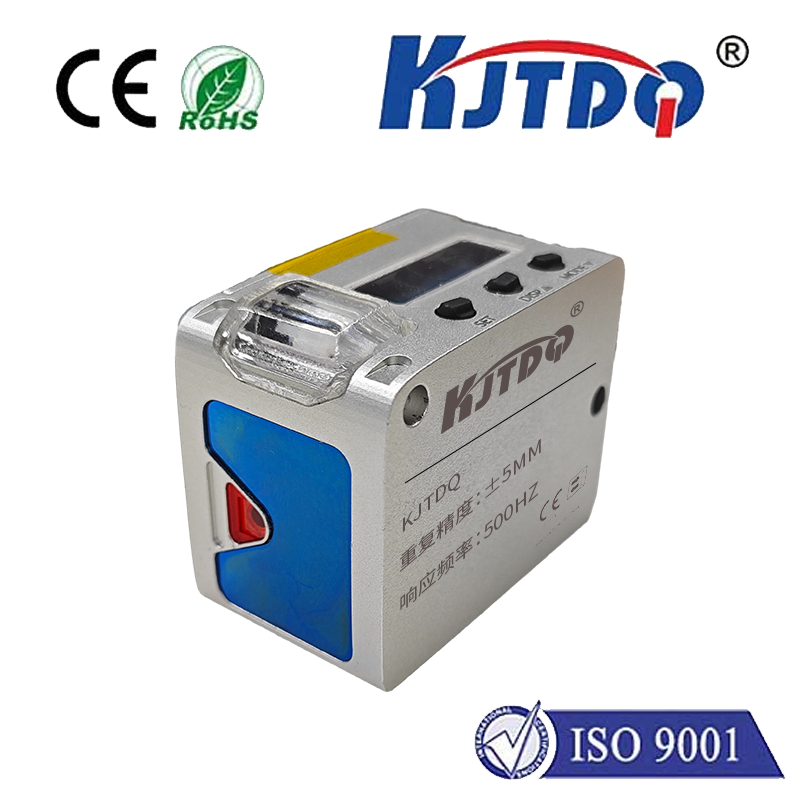
KJT Sensors' laser family covers both duty classes: the TLS series high-accuracy laser sensors for distance and displacement (documented applications: thickness, flatness, profile, position feedback, in-line quality), and model-level anchors such as the TLS-30C — 1 mm resolution, accuracy ±1.5 mm + 0.5‰, output response ≥4 ms, update 5–30 Hz, NPN/PNP plus 0–10 V / 4–20 mA and RS485 Modbus outputs (manufacturer-stated). The distinction between laser distance sensing (absolute distance) and laser displacement sensing (continuous high-accuracy change measurement) is drawn by the manufacturer itself and is expanded in the laser taxonomy comparison ({{URL_E06}}).