check

check

check

check

check

check

check

check

check

check
Foreground suppression is useful when a diffuse photoelectric sensor has to look past something close to it, such as a guard, a mesh panel or the edges of a machine opening, and react only to what happens farther away against a known surface. Background suppression does the opposite: it ignores everything beyond a set distance and switches on objects nearer than that cutoff. KJT Sensors recommends choosing between the two by asking which zone is fixed and which carries the target, then testing real target colours, angles and background distances.

Each mode answers a different distance question. A background suppression sensor asks whether an object is closer than its switching point; anything behind that point is treated as empty space, whatever its colour or shine. A foreground suppression sensor asks whether something has appeared between a known background and a near limit, or whether that background has changed.
Both rely on geometry rather than brightness alone. The emitted spot lands on the receiver at a position that shifts with distance, so the sensor can judge range even when a dark target returns little light. This is why a black carton and a white one can switch at nearly the same point, which a plain diffuse sensor rarely manages.

| Mode | What it ignores | What triggers it | Typical layout |
|---|---|---|---|
| Plain diffuse | Nothing by distance | Enough reflected light | Clear space behind the target |
| Background suppression | Surfaces beyond the cutoff | Objects nearer than the cutoff | Wall, frame or machine part behind the target |
| Foreground suppression | Objects nearer than the near limit | Change against a reference background | Guard, mesh or opening in front of the target zone |
Foreground suppression helps when the sensor cannot sit inside the working area and must look through a fixed structure. Picture a sensor mounted outside a guard, aimed through a slot at a conveyor belt. The slot edges and the mesh are always present and close to the lens; a background suppression sensor set to reach the belt would see them as targets.
With foreground suppression, the near structures are excluded and the belt surface becomes the reference. A product passing over the belt changes what the sensor sees, whether that product is pale, dark or glossy, because the reference return is disturbed either way. The arrangement also suits cases where the target is flat and very low against its background, since a fixed reference is easier to judge than a faint return from the part itself.
The limitation is dependence on the reference. If the belt surface becomes wet, worn or covered in debris, the reference shifts, and the sensor setting needs room for that change.
A trial should cover the smallest gap between target and background that production will ever create, not the typical one. Background suppression needs some distance between the cutoff and the surface behind; when the target is thin and lies almost on that surface, the two returns overlap and the decision becomes uncertain.
Test angle as well as distance. A glossy box tilted away from the sensor throws light aside, and a curved bottle spreads it, so present samples flat, tilted and rotated. Include the darkest and the lightest version of the product, because mixed-colour runs are where intensity-based diffuse sensors usually struggle. Stable mounting, correct lighting, sensible threshold values and an appropriate sensing distance matter here just as much as they do for colour-mark sensors.
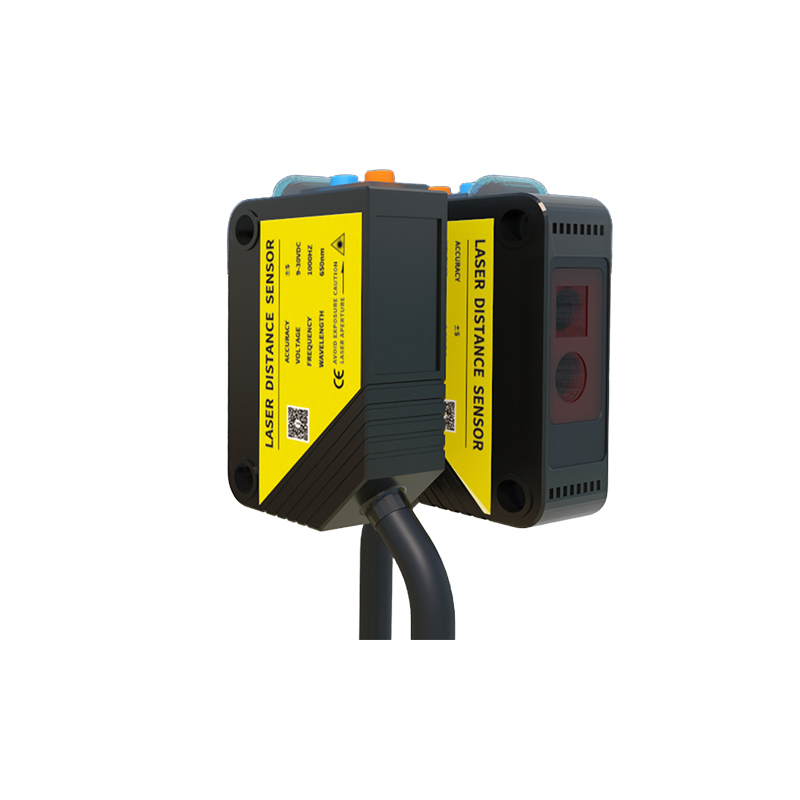
Time-of-flight sensors measure distance directly, which gives them a third way to separate target from background. Distance comes from the time a light signal takes to reach the target and return, not from reflected-light intensity alone, so the result holds steadier than an intensity switch when the target is transparent or has a complex surface, when the range grows, and when strong light falls on the receiver.
KJT describes its ToF photoelectric sensor in terms of a ranging module, a photoelectric-detection module, a background-suppression and interference-rejection module, a high-speed response module, a system-interface module and an industrial-protection module. In use, the ranging module calculates target distance, photoelectric detection confirms presence or in-position status, and background suppression reduces the effects of colour, curvature, reflectivity and ambient light. KJT ToF laser sensors also emphasize adjustable range and stable diffuse reflection, which suits layouts where the background distance varies between machines.
The request should describe the background as carefully as the target. Useful details include the material and finish of the surface behind the target, how far it sits from the sensor, how much that distance can vary, and whether anything sits between sensor and target, such as a guard, window or mesh.
Add the target range: colours, finishes, size, orientation and the closest approach it makes to the background. Mention ambient light near the receiver, and whether the background stays clean during production. KJT photoelectric sensors address presence, location, distance, colour and transparency requirements in automated production, and this information lets a supplier match a suppression mode to the layout instead of guessing.
Can one sensor switch between foreground and background suppression?
Some sensors offer selectable modes, while others are built for one. Check the datasheet of the shortlisted model rather than assuming the option exists.
Why does a thin part on a conveyor confuse a background suppression sensor?
When the part is almost as far away as the belt, its return and the belt's return land in nearly the same place. A larger gap or a reference-based mode separates them more clearly.
Does foreground suppression ignore a dirty viewing window?
It ignores fixed objects nearer than its limit, but dirt on the window still reduces the light reaching the target zone. Plan for the window to be cleaned.
Is a plain diffuse sensor ever the right choice?
Yes, where the space behind the target is open and targets are similar in colour. It becomes unreliable when a bright background or mixed-colour products enter the picture.