

check

check

check

check

check

check

check

check

check

check
For low-contrast targets, choose a sensing method that depends as little as possible on how much light the target reflects. Background suppression and time-of-flight sensors judge distance, so a black carton and a white one switch at nearly the same point; through-beam layouts avoid the question entirely by watching for an interrupted beam. KJT Sensors then checks the remaining margin with the darkest, glossiest and most steeply angled samples the line will run, because a sensor that only sees mid-grey parts during setup tells you little about the night shift's black packaging.
A plain diffuse sensor decides by intensity, and dark or glossy surfaces return the least usable light. Matte black absorbs most of the beam. Gloss reflects strongly but in one direction, so a slight tilt sends the light away from the receiver. When products of different colors share a line, the threshold that catches the black one may be too sensitive for the white one, and the background behind them may return more light than either.
That combination of low return and wide variation is the core difficulty. Fixing a single threshold cannot cover a range of targets whose reflectance spans a wide gap.


Principles based on distance or on beam interruption cope with mixed colors far better than those based on reflected intensity. Each has its own limits, so compare them against the target set rather than in general.
| Principle | What it relies on | Dark target behaviour | Main limitation |
|---|---|---|---|
| Plain diffuse | Amount of reflected light | Reach shrinks sharply | Background and color sensitivity |
| Background suppression | Position of returned spot | Switching point stays close | Needs gap between target and background |
| Time-of-flight | Travel time of the light | Distance reading remains usable | Steep angles on very dark gloss |
| Through-beam | Beam blocked or not | Color has no effect | Needs devices on both sides |
| Retro-reflective | Beam blocked or not | Color has little effect | Reflector and shiny targets |
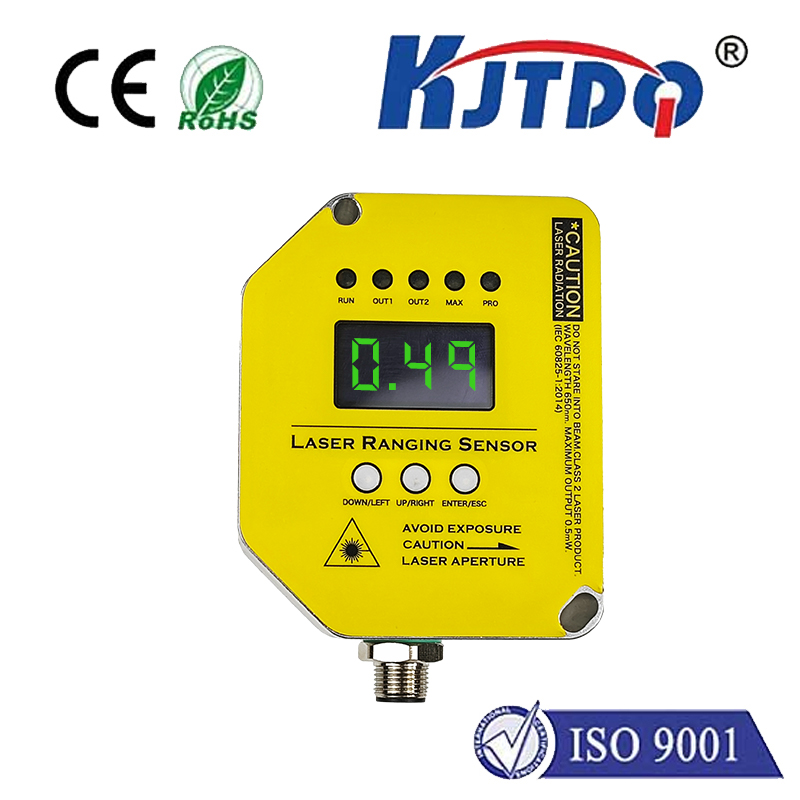
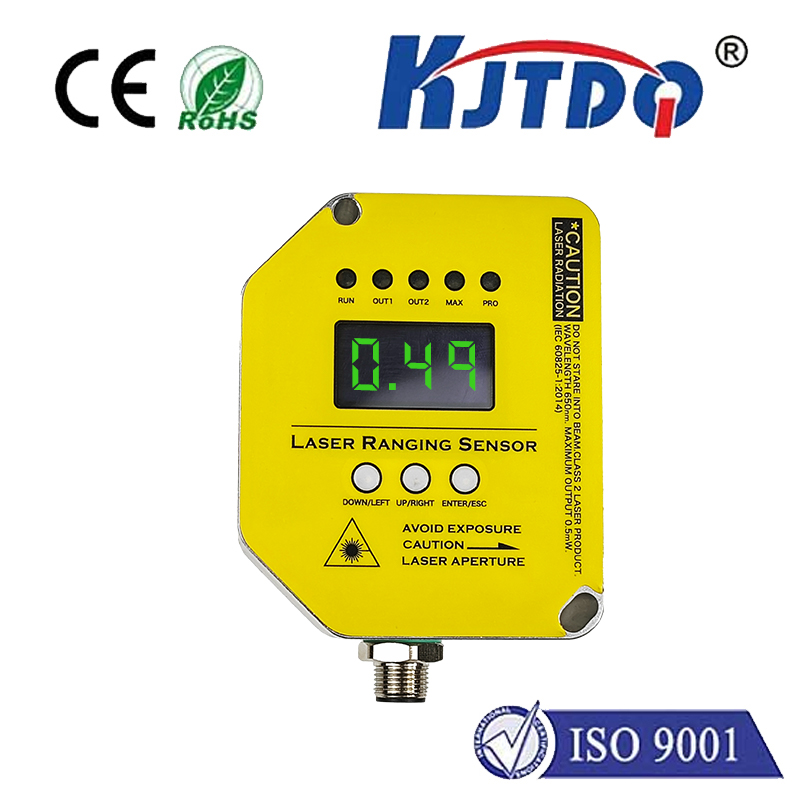
Background suppression reduces the effects of color, curvature, reflectivity and ambient light, which is why it is a common first step away from plain diffuse sensing. ToF goes further by calculating distance from the time a light signal takes to return. Against conventional photoelectric switches it stays steadier at longer distances, in strong light, and on transparent objects or complex surfaces. KJT ToF laser sensors also emphasize adjustable range, higher switching frequency and stable diffuse reflection.
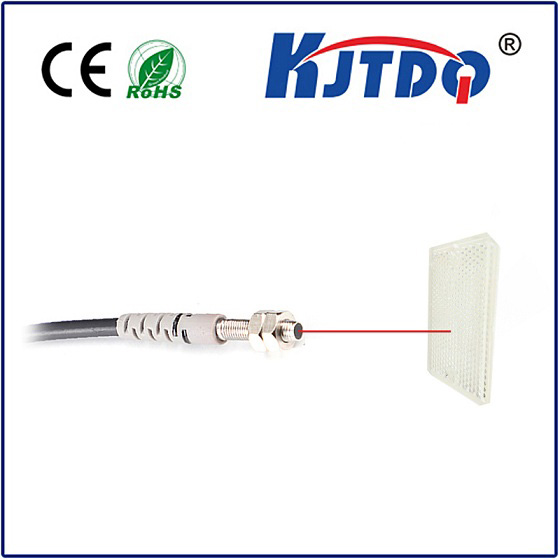
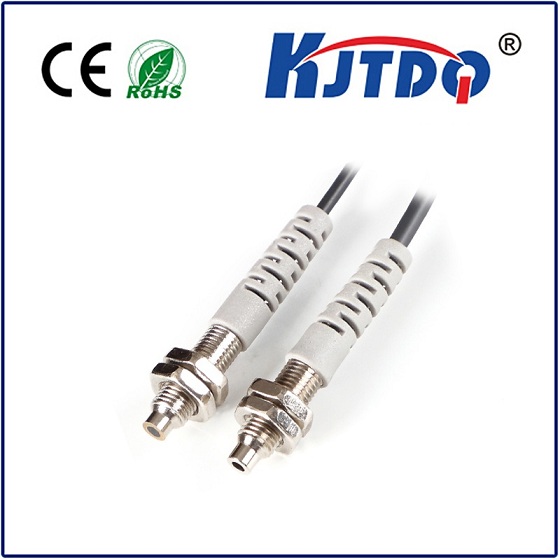
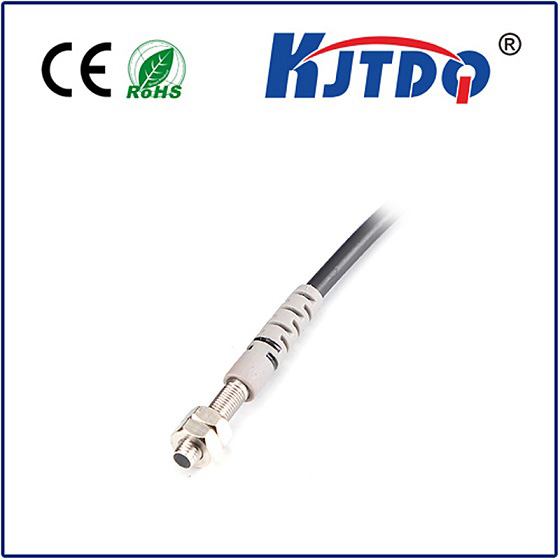
A small target fills less of the light spot, so less of the returned signal comes from the part itself. When the part is also dark, the share of light it contributes can fall below what the sensor can separate from the background. A smaller spot, a laser source or a fiber head concentrates detection on the part. KJT fiber sensors and amplifiers combine fiber lighting, amplification and sensitivity adjustment for small targets and narrow spaces.
Large dark targets bring a different issue: their surfaces are often curved or angled, so the spot hits an edge or a slope. Check the sensor on the curved and angled faces, not only the flat side.
Teach-in suits lines with frequent product changes; manual adjustment suits stable lines with one difficult target. Teach-in and pushbutton settings sample the target and the background in place and place the threshold between them, which supports faster changeovers than manual calibration. Manual adjustment lets an engineer bias the threshold deliberately towards the darkest product.
On contrast and color sensors the same logic applies: color recognition evaluates the difference between mark and background, sensitivity adjustment sets the recognition threshold, and signal processing suppresses background interference. KJT color sensors add light intensity difference judgement and output signal control to support positioning and packaging synchronization.
The test set should span the full range of finishes and colors the line will run, presented at real angles and speeds. Include the darkest matte packaging, the glossiest black item, a white or reflective item, and anything transparent. Show them flat, tilted and moving, and keep the real background behind them, since a bright conveyor or machine frame changes the decision as much as the target does.
Record the sensor's received-light or stability reading for each sample. The gap between the darkest target and the background is the margin you are buying.
Is a ToF sensor always needed for black targets?
No. Background suppression handles many dark targets, and a through-beam layout ignores color entirely. ToF earns its place when angles, distance or ambient light add to the difficulty.
How should a bench evaluation reflect production conditions?
Use the production part rather than a clean, flat sample, and test with the actual background, angle and speed.
How do I compare sensors for products in many colors?
Run the same set of samples past each candidate and compare the margin on the hardest one. A sensor that copes with the darkest and the glossiest usually handles the rest.