

check

check

check

check

check

check

check

check

check

check
Specify a fork sensor from the part path outward. The fork width has to clear the thickest material plus its flutter, the fork depth has to place the beam where the edge or feature actually passes, and the optical resolution has to suit the smallest object or gap that must switch the output. KJT Sensors also asks for target speed and material, because a thin, transparent or fast part can pass through a correctly sized slot and still go unseen if the beam is too wide or the response too slow.
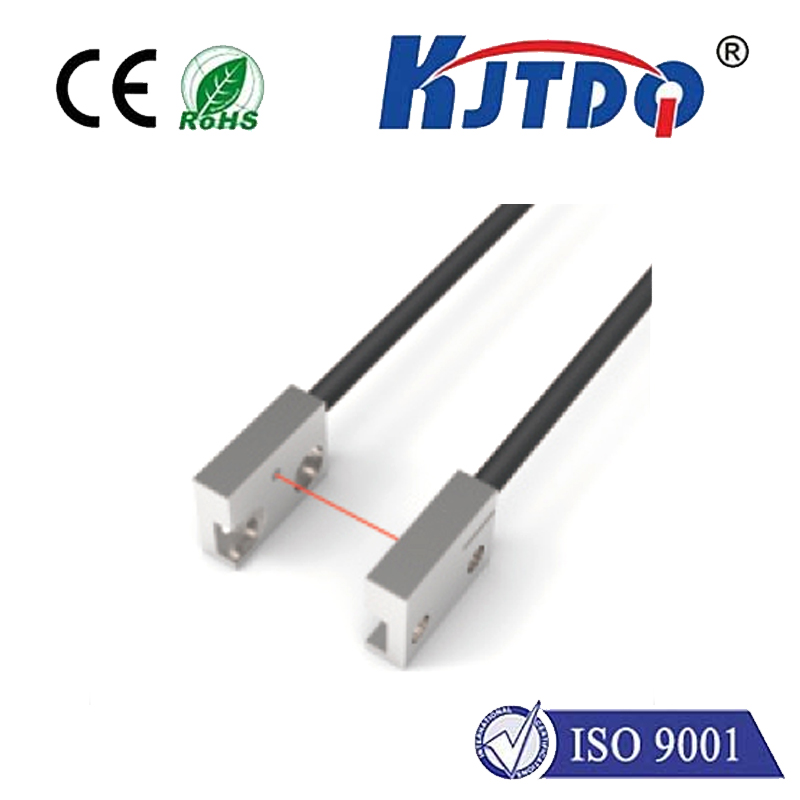
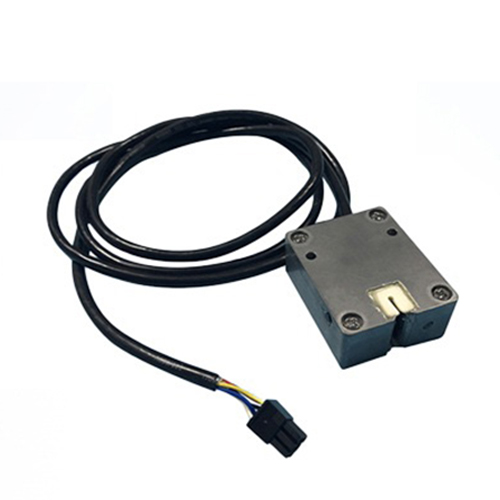
A fork sensor is a through-beam pair built into one U-shaped body, so the emitter and receiver are aligned at the factory and stay aligned. Nothing has to be lined up on site, and vibration that would shift two separate brackets moves both sides of the fork together. Any object that enters the gap interrupts or weakens the beam, and the receiver reacts to that change rather than to light scattered by the target.
That direct path gives a wide signal margin for opaque parts. U-shaped optical slot sensors are used for high-speed edge detection and positioning on sheet material, strip feeding and rotating index tabs, where the part moves through a predictable line.


Choose the narrowest width that still lets the material pass freely through every stage of the process. A web that flutters, a tab that wobbles on a rotating disc or a part that bounces on a feeder all need clearance beyond their nominal thickness, but a slot much wider than necessary leaves more room for the target to drift away from the beam's centre.
Depth is a separate decision. It sets how far the optical axis sits from the open edge of the fork, which decides how far the target must enter before it is seen. For web-edge or sheet positioning, match the depth to where the edge runs and how much it wanders. For tabs on a wheel, the tab has to reach the beam fully on every pass.
| Dimension or property | What it controls | What to measure on the machine |
|---|---|---|
| Fork width | Clearance for the moving material | Thickest part plus flutter or bounce |
| Fork depth | Where the beam sits relative to the opening | Edge position and how far it wanders |
| Optical resolution | Smallest object or gap that switches reliably | Smallest feature, hole or label gap |
| Response speed | Shortest event the output can follow | Feature size against line speed |
| Beam type | Signal margin on the target material | Opacity, transparency and colour |
The beam cross-section sets it. If a small pin, wire or tab covers only part of the beam, the receiver still gets most of its light and may not switch. A narrower beam or an aperture concentrates detection into a smaller area, so a smaller object interrupts a larger share of the light.
Speed adds a second limit. A small part moving quickly blocks the beam for a very short time, and the output must respond within that window. Compare the time the feature spends in the beam with the sensor's response time before fixing the selection, and leave margin for the fastest operating speed rather than the normal one.
It can, provided the sensor is chosen for the material rather than for opaque parts. Clear film and transparent labels let much of the light through, so the change between label and backing or between film and gap is small. Optical fork sensors used for labels rely on that difference and need a sensitivity setting that separates the two levels.
Where optical contrast is too weak, ultrasonic sensing is the alternative to compare. KJT ultrasonic label sensors provide non-contact measurement, compatibility with multiple materials, good directionality and fast response, which suits transparent labels and complex web materials. KJT label sensors are designed for label presence, label-gap identification, labeling-machine control, packaging-material positioning and automated labeling. Printed registration marks belong to a different group: colour mark sensors handle printing, cutting, tagging, thin film and paper positioning tasks.
Consider a fiber head when the fork body cannot reach the detection point. Fiber-optic sensors guide light through an optical fiber to the measurement point, which allows non-contact detection of small targets in confined spaces and difficult locations. Against an integrated housing, a fiber is the better fit when installation space is limited, when the detection point is tiny, or when no sensor body can be positioned near the target. A pair of opposed fiber heads keeps the through-beam principle while the amplifier sits elsewhere.
Does a wider fork always make installation easier?
It eases clearance but can cost accuracy, because the target has more room to move away from the beam centre. Size the slot to the material path, not to convenience.
How is a fork sensor used for counting small parts?
Parts pass through the gap one at a time and each one breaks the beam. Check that the beam is narrow enough for the part and that the response keeps up with the feed rate.
Is a fork sensor suitable for metal tabs on a rotating disc?
Yes, an optical fork detects the tab edge regardless of material, provided depth and width match the tab position. An inductive slot sensor is the alternative when only metal must be detected.
What sample information helps a supplier recommend a fork size?
Send material thickness, flutter, edge position, smallest feature, line speed and a sample of the material, especially if it is transparent or printed.