check
check
check
check
check
check
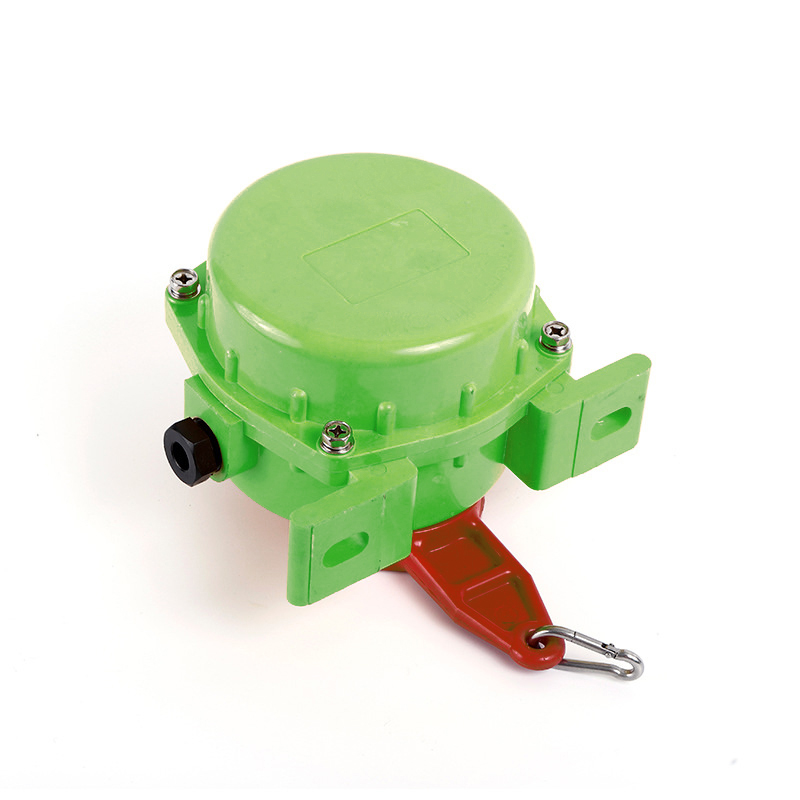
A pull-cord switch must be positioned so that any person walking or working along the conveyor can reach the cord quickly, which makes switch spacing a site-safety decision driven by access routes, applicable safety rules and rope sag — not a fixed catalogue value. Belt-misalignment switches must be positioned where belt drift actually causes damage: at the head and tail pulleys, at transfer points and along sections where the belt leaves the normal track. KJT Sensors supplies both device families, including the KJT-LSTD pull-cord switch with manual or automatic reset, and states a typical spacing of 30–50 m per switch configured for the site. Final placement always requires a site risk assessment by a qualified conveyor or machine-safety engineer.
Pull-cord switch spacing is a site decision: KJT Sensors' product data for the KJT-LSTD gives a typical spacing of 30–50 m per switch, configured for the specific conveyor length, walkway layout and applicable safety standards.
Reachability — not distance — is the core requirement: the cord must be graspable along the entire accessible conveyor length, on both sides where personnel work.
Belt-misalignment switches observe the belt edge, and are concentrated at pulleys, transfer points and known drift zones; they issue warning and shutdown signals rather than emergency stops.
Reset philosophy separates the two devices: a manual-reset pull-cord switch latches until an operator confirms the emergency is cleared; misalignment switches commonly use automatic or field-verified reset for condition monitoring.
Every spacing value, mounting height and trip-angle setting in a real project must be confirmed against the site risk assessment and applicable local safety regulations.
Both device families fail in the same way when positioned badly: a pull-cord switch that is too far from a walkway cannot be reached in an emergency, and a misalignment switch mounted where the belt never drifts detects nothing. Positioning is therefore an engineering task, not an accessory choice.
KJT Sensors positions these products as part of a complete conveyor protection portfolio — pull-cord switches, belt misalignment switches, two-way pull-cord switches, slip detection devices, plugged-chute switches, longitudinal tear detectors, material level/flow switches and audible and visual alarms — configured around conveyor length, belt width, speed, material and control-system interfaces (manufacturer-stated, Conveyor Belt Switch Series).
The system-level view — which devices a conveyor needs at all — is covered in the conveyor belt protection system guide ({{URL_D01}}). This article covers only the positioning of the two line-side families.
A pull-cord switch provides emergency-stop protection along the conveyor line. Steel wire ropes installed along the conveyor sides can be pulled at any point to actuate the switch, interrupt the conveyor control circuit and stop the system (manufacturer-stated, KJT-LSTD product data). Placement must therefore guarantee:
Continuous reachability — no accessible point on the conveyor should be more than a short step from the cord.
Both sides where personnel work — walkways on both sides require cord coverage on both sides.
Unobstructed cord run — the rope must run without snagging on structure, idlers or material chutes.
Reset access — a manual-reset model must be reachable by the responding operator, because the conveyor cannot restart until the reset button is pressed.