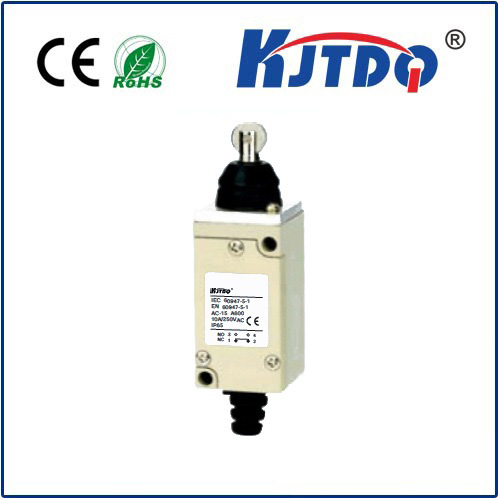
snap action limit switch
- time:2025-08-03 01:35:58
- Click:0
Snap Action Limit Switches: Precision Switching for Reliable Control Systems
Imagine a robotic arm moving at high speed towards its programmed limit. Or a safety gate on heavy machinery that must trigger an immediate shutdown if opened unexpectedly. In countless applications demanding absolute reliability and instantaneous response, a specific type of switch reigns supreme: the snap action limit switch. This unassuming component is an engineering cornerstone in automation, safety systems, and industrial controls, delivering critical performance where timing and precision are non-negotiable.
But what exactly is a snap action limit switch? At its core, it’s a mechanically operated switch designed to change its electrical state (open or close a circuit) with exceptional speed and decisiveness when an actuator (like a plunger, lever, or roller) is moved by an external force to a predetermined position – its “limit.”
The defining characteristic lies in the “snap action” mechanism. Unlike slower-acting switches where contacts may sluggishly slide or hesitate during transition, a snap action switch incorporates a clever over-center spring assembly. When the actuator is displaced, this spring stores energy until it instantly “snaps” past a critical point. This rapid, positive movement forces the electrical contacts to open or close with remarkable speed, independent of the speed at which the actuator itself is moving. This feature is crucial for several reasons:
- Spark Minimization: The abrupt separation or connection of contacts drastically reduces the time they spend in a partially open/closed state during arcing. This significantly minimizes contact erosion caused by electrical arcing, especially when switching inductive loads like motors or solenoids. Longer contact life translates directly to enhanced reliability and longevity.
- Positive Operation: The snap action ensures a clean, unambiguous switching event. There’s no “mushy” transition zone. The switch is definitively ON or OFF, providing a clear, unambiguous signal to the control system.
- Immunity to Operator Speed: Whether an actuator is pushed slowly or slammed quickly, the internal snap action ensures the contact transition happens at the same, consistent speed. This makes the switch highly predictable and repeatable.
- Differential Travel: A key spec for these switches is their differential travel (also called reset travel). This is the distance the actuator must move back from its tripped position before the contacts reset. The snap action mechanism creates a distinct gap between the activation point (where it trips) and the reset point, providing built-in hysteresis that prevents chattering near the set point.
Inside the typically rugged metal or high-grade plastic housing, you’ll find carefully engineered components. The precise spring mechanism is the heart of the snap action. Electrical contacts, often made of silver alloys or other durable conductive materials, are designed to handle the specified electrical load (voltage and current - AC or DC). The actuator type varies widely depending on the application: standard plungers, various lever arms (with or without rollers), whisker actuators for delicate positioning, or even rotary actuators.
Where do you encounter these critical components? Their applications are vast and fundamental to modern industry and safety:
- Industrial Automation & Machinery: Position sensing on conveyors, robotic arms, CNC machines, packaging lines, and presses to control movement sequences, detect end-of-travel, or signal part presence/absence.
- Safety Interlocks: Guard doors on machinery must instantly stop operation when opened. Snap action switches provide the fail-safe switching required in safety circuits (often integrated into safety relays/controllers).
- Material Handling: Detecting gate positions, pallet alignment, lift height limits in forklifts or elevators, and hoist over-travel protection.
- Appliance Controls: Used in washing machines, dryers, dishwashers, and ovens for door interlocks and position detection.
- Transportation: Door position sensing on trains, buses, and aircraft; landing gear position indicators.
- HVAC Systems: Damper position control, air flow sensing.
The advantages of snap action designs over slower, “slow-make, slow-break” switches are compelling:
- Enhanced Durability: Significantly reduced contact arcing extends operational life.
- High Repeatability: Consistent operation point-to-point ensures process reliability.
- High-Speed Suitability: Capable of reliable operation in fast-cycling applications.
- Noise Immunity: The decisive action prevents contact “chatter” that can cause erratic signals or control instability.
- Over-Travel Tolerance: The design inherently allows the actuator to move beyond the triggering point without damaging the switch internals – a critical feature when dealing with mechanical stops or varying forces.
Selecting the right snap action limit switch requires careful consideration:
- Electrical Ratings: Choose the appropriate voltage (AC/DC) and current rating (amperage) for the load being switched. Undersizing leads to premature failure.
- Actuator Style: Match the actuator (roller lever, plunger, wobble stick, etc.) to the physical movement being detected. Consider the force required to activate it.
- Environmental Factors: IP rating for dust and moisture resistance, temperature range, and resistance to oils or chemicals are vital for harsh industrial settings.
- Electrical Configuration: Specify the required contact arrangement (SPST - Single Pole Single Throw, SPDT - Single Pole Double Throw, etc.) – normally open (NO) or normally closed (NC).
- Mechanical Life: Expected number of mechanical operations (often millions).
- Electrical Life: Expected number of operations under specified electrical load (usually less than mechanical life due to contact wear).
- Mounting: Ensure the switch body and actuator orientation suit the physical installation.
The snap action limit switch remains an indispensable, highly reliable solution for precision position sensing and safety-critical switching across countless industries. Its ingenious mechanical design, centered around that definitive snap, provides the level of performance, durability, and repeatability demanded by modern control and safety systems. Understanding its operation, advantages, and selection criteria empowers engineers and technicians to implement robust and dependable solutions, ensuring machinery operates safely, efficiently, and within its intended boundaries. From the simplest home appliance to the most complex factory robot, the snap action limit switch quietly performs its vital role, one precise snap at a time.