check

check

check

check
check
check
check
check

check

check

In high-speed automated production lines, every assembly, inspection, and sorting operation of components depends on stable and reliable data.
However, in precision manufacturing sites, the real headaches are often not the large problems visible to the naked eye, but displacement deviations so tiny they are difficult to notice.
A 0.010 mm tolerance deviation, a 0.08 mm offset, a 0.025 mm micro-displacement…
They may seem small, but they are enough to affect product quality, sorting results, and production line stability.
The first episode of Season 2 of KJT Industrial Rescue Story, “Tiny Displacements Cannot Be Measured Accurately,” officially begins.
This time, the rescue hero is the KJT-KELR-TE high-precision displacement sensor.
In automated production lines for precision components, equipment operates at high speed and workpieces move continuously. Any slight height change, position deviation, or assembly error can cause unstable inspection results.
At the beginning of the comic, the quality monitoring system issues an NG alarm, the screen shows a rising defect rate, and on-site personnel are anxious about tiny displacement errors.
“Such a small difference can’t be seen with the naked eye!”
This is a real challenge in many industrial sites: tiny deviations are not easy to observe, and traditional inspection methods have difficulty identifying them consistently. Once data fluctuates, it may cause misjudgment, missed detection, or even affect the rhythm of the entire production line.
Facing the problem of inaccurate micro-displacement measurement, KJT engineers bring in the KJT-KELR-TE high-precision displacement sensor.
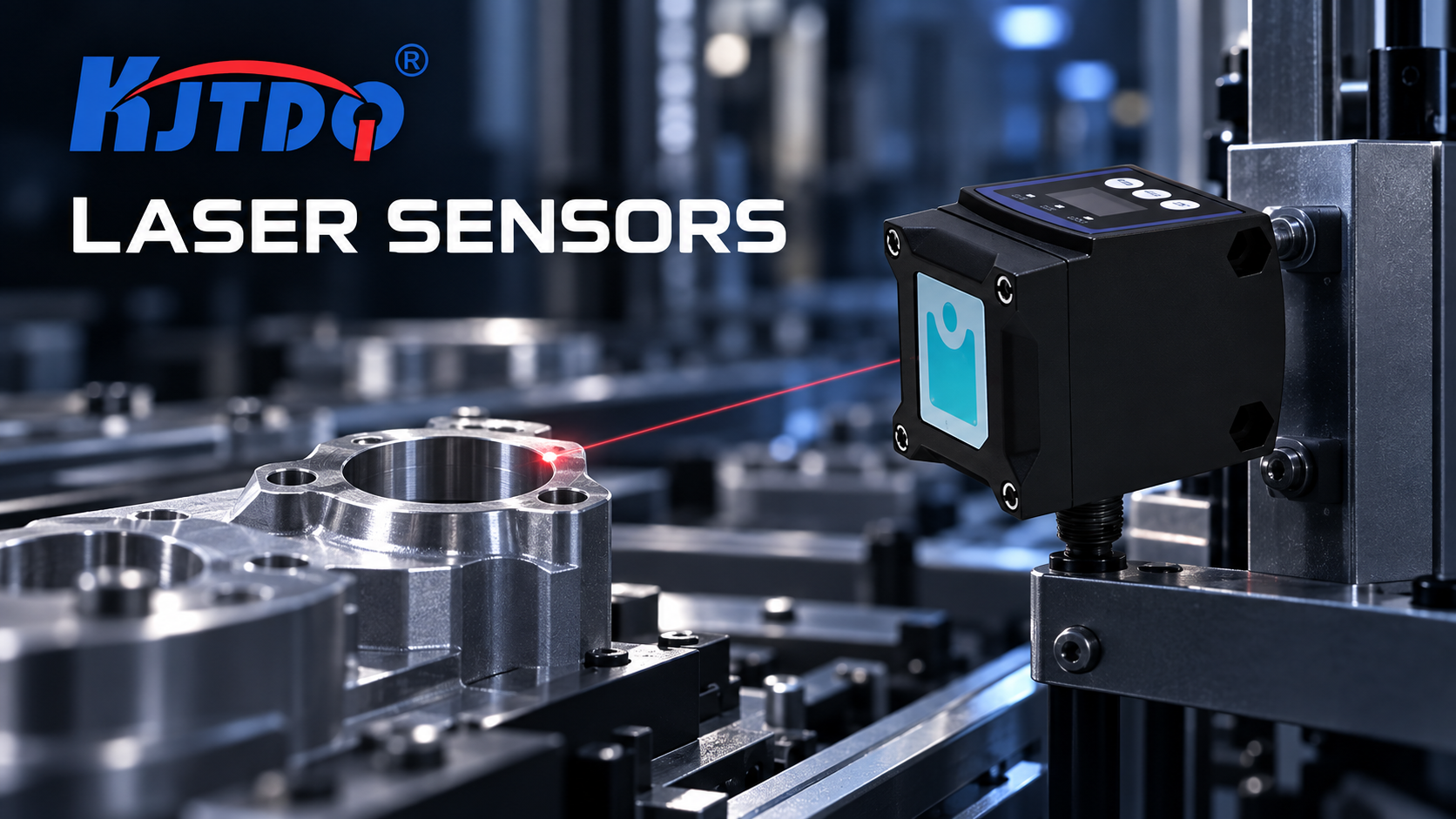
This product uses laser triangulation measurement to accurately capture tiny displacement changes on the target surface, achieving high-precision non-contact measurement.
In the comic, the sensor detects the displacement of the workpiece, clearly identifies a tiny 0.025 mm change, and outputs the measurement data stably through the system.
“Even tiny displacement can be seen clearly.”
This is not only a demonstration of product performance, but also a response to the inspection needs of precision industrial sites.
The KJT-KELR-TE high-precision displacement sensor is designed for industrial scenarios such as precision manufacturing, automated inspection, component sorting, and assembly positioning. It offers multiple core advantages:
Micron-Level Accuracy
Captures tiny displacement changes and is suitable for precision dimensional inspection, position deviation identification, and height change monitoring.
CMOS Receiving Technology
Stably collects reflected signals and improves inspection reliability on complex surfaces and in industrial environments.
Stable Anti-Interference Performance
Adapts to complex factors such as lighting, dust, and vibration on production lines, ensuring stable data output.
Compact and Easy to Install
Small in size and easy to integrate into automation equipment, inspection stations, assembly mechanisms, and sorting systems.
In the next episode, KJT Industrial Rescue Story will continue to go deep into industrial sites and face new inspection challenges.