check

check

check

check

check

check
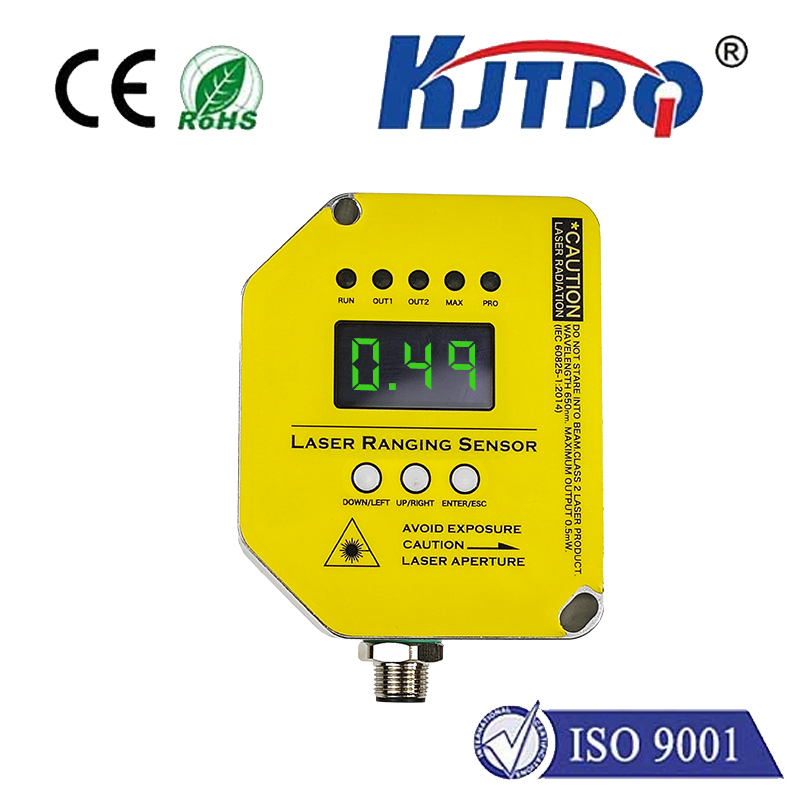
In the world of industrial automation, robotics, and high-precision manufacturing, the ability to measure distance and displacement with micron-level accuracy is not just an advantage—it's a necessity. This is where the displacement laser rangefinder sensor steps into the spotlight. Unlike traditional contact measurement tools or less precise optical methods, this technology offers a non-contact, high-speed, and exceptionally accurate solution for a myriad of demanding applications.
At its core, a displacement laser rangefinder sensor operates on the principle of laser triangulation or time-of-flight measurement. In the widely used triangulation method, a laser diode projects a focused beam of light onto the target surface. The reflected light is then captured by a sensitive receiver, typically a CCD or CMOS linear array, at a known angle. By calculating the position of the laser spot on the receiver, the sensor's internal processor can determine the exact distance to the target with remarkable precision. This method excels at short to medium ranges, delivering resolutions down to the sub-micron level. For longer ranges, time-of-flight sensors measure the round-trip time of a laser pulse to calculate distance.
The benefits of integrating a displacement laser rangefinder sensor into your system are profound. First and foremost is its non-contact nature. This eliminates the risk of damaging delicate surfaces, prevents wear and tear on the measuring tool itself, and allows for measurements on hot, vibrating, or otherwise inaccessible objects. Speed is another critical factor. These sensors can perform thousands, even hundreds of thousands, of measurements per second, enabling real-time process control and 100% inline inspection in high-speed production lines. Furthermore, their high accuracy and repeatability ensure consistent product quality, reduce waste, and facilitate tighter tolerances in manufacturing.
Practical applications are vast and varied. In the automotive industry, these sensors are indispensable for measuring body panel gaps, inspecting weld seams, and controlling robot positioning. In electronics manufacturing, they verify the coplanarity of chip leads, measure solder paste thickness, and inspect component placement. They play a crucial role in controlling roll diameters and thickness in paper and metal rolling mills. In research and development labs, they are used for vibration analysis, surface profiling, and material deformation testing. Even in emerging fields like autonomous vehicle navigation and drone landing systems, laser displacement sensors provide vital environmental data.
Selecting the right displacement laser rangefinder sensor requires careful consideration of several key parameters. The measuring range defines the minimum and maximum distances the sensor can handle. Resolution indicates the smallest detectable change in distance. Linearity error specifies the deviation from a perfect straight-line response across the range. The spot size of the laser affects the minimum feature that can be measured, while the sampling rate determines how fast measurements can be taken. Environmental factors like ambient light, temperature fluctuations, and the target's surface properties (color, reflectivity, texture) must also be evaluated, as they can impact performance. Modern sensors often come with sophisticated software that can filter noise, compensate for material differences, and output data in various formats for seamless integration with PLCs, PCs, and data acquisition systems.
Looking ahead, the evolution of displacement laser rangefinder sensors points towards even greater miniaturization, higher speeds, and enhanced intelligence. Integration with AI and machine learning algorithms will allow sensors to not only collect data but also identify trends, predict anomalies, and make autonomous adjustments to processes. Multi-point and profile scanning sensors, which capture entire cross-sections rather than a single point, are expanding the possibilities for 3D inspection and complex shape analysis.
In conclusion, the displacement laser rangefinder sensor is a foundational technology for modern precision engineering. By delivering fast, accurate, and reliable non-contact measurements, it empowers industries to achieve new levels of quality control, efficiency, and automation. Whether for routine inspection or cutting-edge research, understanding and leveraging this powerful tool is key to staying competitive in a world where precision is paramount.