check

check

check

check
check
check
check
check

check

check
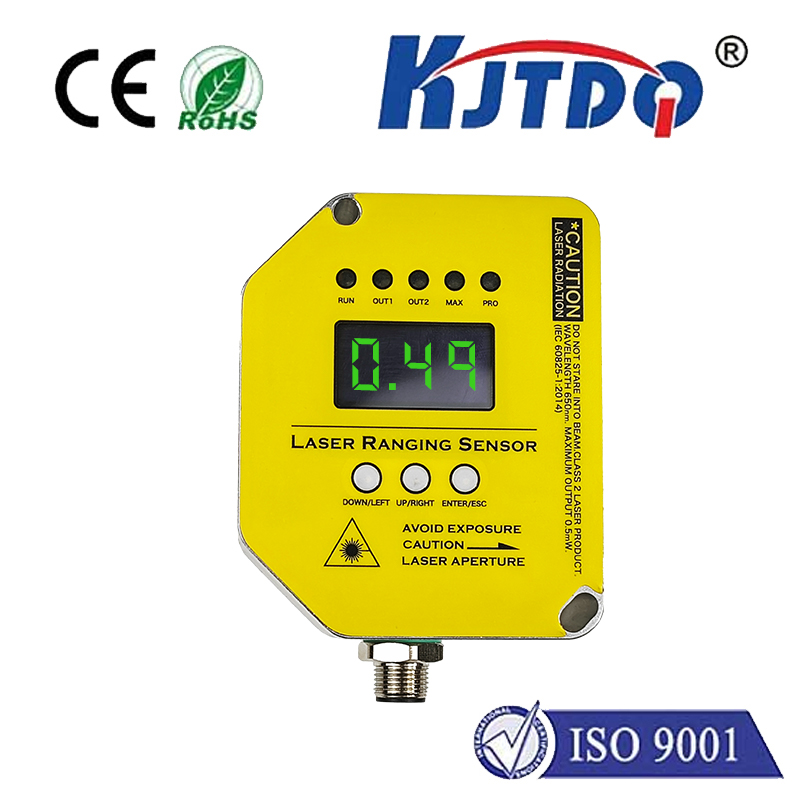
In the rapidly evolving landscape of automation, robotics, and smart technology, the demand for accurate, reliable, and fast distance measurement is paramount. Among the various sensing technologies available, the Time-of-Flight (TOF) Laser Ranging Module stands out as a superior solution, offering unparalleled precision and versatility. This guide delves into the core principles, key advantages, and diverse applications of the TOF Laser Ranging Module, with a focus on the high-performance KJTDQ series, illustrating why it has become an indispensable component in modern engineering.
At its heart, a TOF Laser Ranging Module operates on a straightforward yet powerful principle. It emits a short pulse of laser light towards a target. The light reflects off the target's surface and returns to the module's sensor. A highly precise internal clock measures the exact time elapsed between the emission and the reception of the light pulse. Since the speed of light is a known constant, the module can calculate the distance to the target with exceptional accuracy using the formula: Distance = (Speed of Light × Time of Flight) / 2. This direct measurement method is inherently robust and less susceptible to environmental interference compared to other techniques like triangulation.
The KJTDQ series of TOF modules exemplifies the cutting-edge of this technology. Engineered for industrial-grade performance, these modules offer significant benefits that set them apart. First and foremost is their high precision and long range. Capable of measuring distances from a few centimeters to several tens of meters with millimeter-level accuracy, they are suitable for both close-quarter inspections and large-scale mapping. Secondly, their measurement speed is remarkably fast, often achieving thousands of measurements per second. This high frequency is critical for real-time applications such as autonomous vehicle navigation or dynamic gesture recognition, where latency is unacceptable.
Another standout feature is their insensitivity to target characteristics. Unlike traditional optical sensors that can be fooled by the color, texture, or material of an object, a TOF laser module's accuracy remains largely unaffected. Whether measuring a dark, matte surface or a bright, reflective one, the KJTDQ module delivers consistent and reliable data. Furthermore, these modules are typically compact, low-power, and designed for easy integration into existing systems via standard communication protocols like UART, I2C, or CAN bus, making them a favorite among product developers.
The practical applications of the TOF Laser Ranging Module KJTDQ are vast and growing. In the field of robotics and drones, they are essential for obstacle avoidance, terrain mapping, and precise landing. Autonomous vehicles and AGVs (Automated Guided Vehicles) rely on them for creating a 3D perception of their surroundings, enabling safe navigation in complex environments. In industrial automation, these modules facilitate precise positioning, bin picking, and volume measurement on production lines. Beyond industry, they are found in consumer electronics for features like camera autofocus, and in smart buildings for people counting, occupancy detection, and touchless interfaces.
When selecting a TOF module like the KJTDQ for a project, several technical specifications require careful consideration. The required measurement range and accuracy are primary drivers. The field of view (FOV) determines the coverage area; a wide FOV is good for general detection, while a narrow FOV allows for precise targeting. Data output rate, power consumption, and environmental ratings for factors like ambient light immunity and operating temperature are also crucial for ensuring reliable performance in the intended setting.
In conclusion, the TOF Laser Ranging Module represents a significant leap forward in distance sensing technology. The KJTDQ series, with its robust design, high precision, and fast response, provides engineers and innovators with a powerful tool to solve complex spatial measurement challenges. As the Internet of Things (IoT) and intelligent systems continue to expand, the role of accurate and efficient ranging modules will only become more central, driving innovation across countless sectors from manufacturing to personal electronics.