check

check

check
check
check
check
check
check

check

check
In the world of industrial automation, robotics, and smart systems, achieving precise distance measurement without physical contact is a fundamental requirement. Among the various technologies available, the diffuse reflection laser rangefinder sensor stands out as a versatile and reliable solution for countless applications. Unlike through-beam sensors that require a separate receiver or specular reflection sensors that depend on a mirrored surface, diffuse reflection sensors operate on a simpler, more adaptable principle. They emit a laser beam towards a target, and a receiver within the same housing detects the light that is scattered back from the object's surface. This "one-unit" design simplifies installation and setup dramatically.
The core advantage of the diffuse reflection laser sensor lies in its ability to measure distance to a wide variety of surfaces, regardless of color or material texture, within its specified range. Whether it's detecting the presence of a cardboard box on a conveyor belt, positioning a robotic arm for pick-and-place operations, or monitoring the fill level of a silo containing granular material, this sensor provides a consistent and accurate reading. Its performance is particularly valuable in environments where the target object is non-cooperative—meaning it is not a perfect reflector and may have varying colors or finishes. The sensor's internal processor calculates the time-of-flight or phase shift of the laser pulse to determine the exact distance to the target.
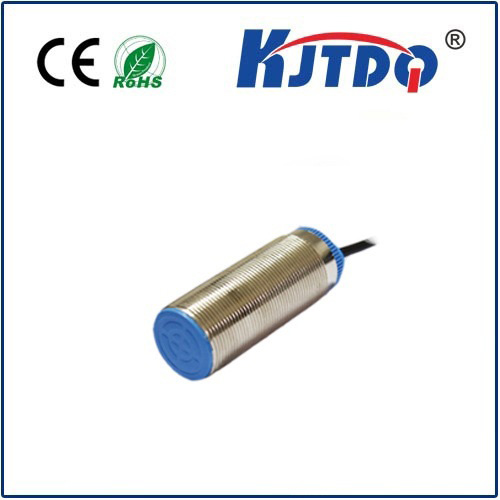
Modern diffuse reflection laser rangefinders, like those represented by the KJTDQ series, incorporate advanced features to enhance their robustness and usability. Many models offer programmable switching outputs, allowing them to trigger an action when an object is within a certain defined window. High-speed response times enable their use in dynamic, fast-moving production lines. Furthermore, resistance to ambient light interference and built-in temperature compensation ensure stable readings even in challenging factory conditions. The housing is typically designed to meet IP67 or similar ratings, providing protection against dust and water ingress, which is crucial for harsh industrial environments.
When selecting a diffuse reflection laser sensor for an application, several key parameters must be considered. The measuring range is paramount; it must suit the specific working distance. The spot size of the laser beam affects resolution and the ability to detect small objects. Repeat accuracy, often in the sub-millimeter range, determines the consistency of measurements. The type of output—analog (4-20mA, 0-10V) or digital (PNP/NPN)—must be compatible with the control system, such as a PLC. For applications involving very dark or absorbent materials, choosing a sensor with sufficient excess gain is essential to ensure a strong enough return signal.
The practical applications are vast and span multiple industries. In logistics and packaging, these sensors count items, check fill levels in bottles, and control conveyor gate operations. In automotive assembly, they ensure precise positioning of components. In woodworking and metal fabrication, they measure material thickness or control cutting tools. Even in agricultural machinery, they can be used for guidance and control. The KJTDQ series, with its focus on reliability and precision, exemplifies how this technology integrates seamlessly into automated processes, driving efficiency and reducing errors.
In conclusion, the diffuse reflection laser rangefinder sensor is an indispensable tool for modern industrial measurement and control. Its non-contact nature, adaptability to diverse surfaces, and high precision make it a superior choice over mechanical or ultrasonic methods in many scenarios. By understanding its operating principle and key selection criteria, engineers and system integrators can effectively deploy sensors like the KJTDQ to solve complex positioning, detection, and measurement challenges, ultimately contributing to smarter, more responsive, and more efficient automated systems.