check

check

check

check
check
check
check
check

check

check
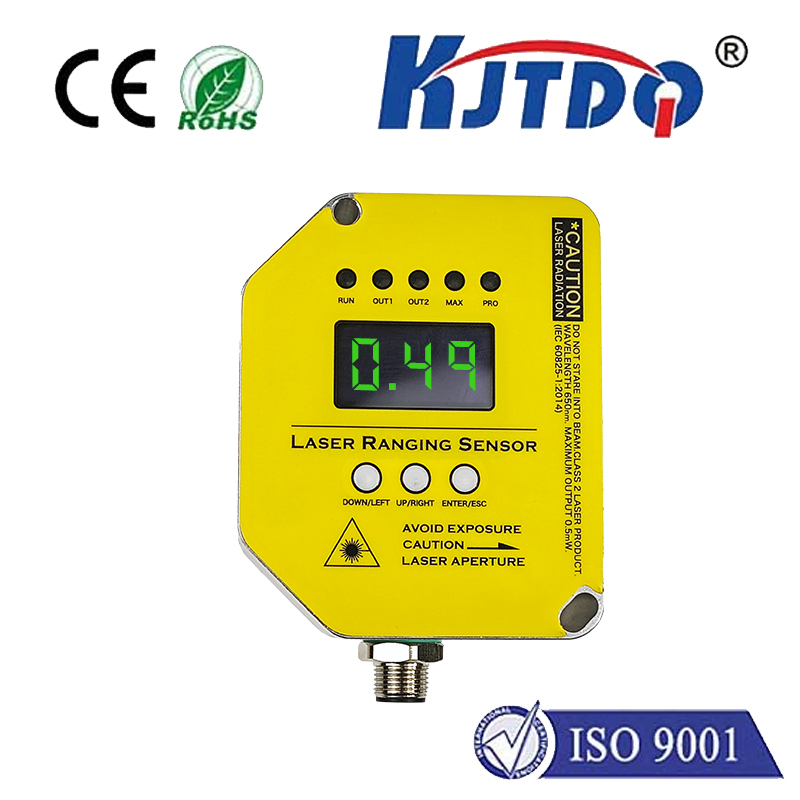
In the rapidly evolving landscape of industrial automation and robotics, the demand for precise, reliable, and non-contact measurement solutions has never been greater. Among the forefront technologies meeting this demand is the laser ranging laser sensor. This sophisticated device utilizes laser beams to accurately determine the distance to a target object, providing critical data for a myriad of applications. Unlike traditional mechanical or ultrasonic methods, laser-based ranging offers unparalleled accuracy, high speed, and the ability to operate in challenging environments.
The core principle behind a laser ranging sensor is time-of-flight (ToF) or phase-shift measurement. In the ToF method, the sensor emits a short pulse of laser light towards the target. A high-speed detector then captures the reflected light. By precisely calculating the time difference between the emission and reception of the pulse, the sensor computes the distance with exceptional accuracy. This process occurs in microseconds, enabling real-time distance monitoring essential for dynamic systems. For even higher precision over shorter ranges, phase-shift analysis is employed, where the sensor measures the phase difference between the emitted and reflected continuous-wave laser beam.
The advantages of integrating laser ranging sensors into industrial systems are substantial. First and foremost is precision. These sensors can achieve sub-millimeter accuracy, which is crucial for quality control in manufacturing, such as verifying component dimensions, monitoring assembly gaps, or ensuring correct positioning. Speed is another key benefit. The non-contact nature and fast response time allow for high-throughput inspection on production lines without causing bottlenecks or wear on parts. Furthermore, laser sensors are highly versatile. They can measure a wide variety of materials, including metals, plastics, glass, and liquids, regardless of color or surface texture in most cases, provided the surface is not perfectly mirror-like. Their compact design and robustness also make them suitable for integration into tight spaces and harsh conditions where dust, vibrations, or variable lighting might hinder other sensor types.
Practical applications of laser ranging laser sensors span numerous industries. In automotive manufacturing, they are used for robotic guidance, weld seam tracking, and panel gap inspection. Within the electronics sector, these sensors ensure the precise placement of components on circuit boards. Logistics and warehousing benefit from their use in automated guided vehicles (AGVs) for navigation and pallet height measurement. Even in agriculture, laser ranging aids in autonomous vehicle guidance and crop monitoring. The technology also plays a vital role in construction for leveling and surveying, and in security systems for perimeter protection.
When selecting a laser ranging sensor for a specific application, several technical parameters require careful consideration. The measuring range defines the minimum and maximum distances the sensor can handle effectively. Resolution indicates the smallest distance change the sensor can detect, while linearity refers to the accuracy consistency across the entire measuring range. The laser spot size is important for targeting small features, and the response time or sampling rate determines how quickly measurement data is updated. Environmental ratings for temperature, humidity, and ingress protection (IP rating) are critical for reliability in industrial settings. Modern sensors often come with intelligent features like programmable measurement windows, analog and digital outputs, and connectivity options for Industry 4.0 integration.
The future of laser ranging technology is closely tied to advancements in laser diodes, detector sensitivity, and signal processing algorithms. Trends point towards sensors becoming even smaller, more energy-efficient, and smarter. The integration of multi-pixel ToF sensors is enabling not just single-point distance measurement but also basic 3D profiling. Furthermore, the fusion of laser ranging data with other sensor inputs, like vision cameras, is creating more robust and intelligent perception systems for autonomous robots and complex automated tasks. This continuous innovation ensures that laser ranging laser sensors will remain a cornerstone technology for precision measurement, driving efficiency and enabling new levels of automation across global industries. Their role in facilitating the transition towards smarter, more adaptive, and data-driven industrial operations is indisputably central.