check

check

check

check

check

check
In the demanding world of industrial automation, precision is not just a goal; it's a fundamental requirement. From robotic assembly lines to automated warehousing and quality control systems, the ability to measure distances with high accuracy and reliability directly impacts efficiency, safety, and product quality. This is where the analog output laser rangefinder sensor, a cornerstone technology in modern sensing, proves its indispensable value. Unlike simple on/off sensors, these advanced devices provide continuous, real-time distance data, enabling sophisticated control and feedback loops that are critical for complex automation tasks.
An analog output laser rangefinder sensor operates on the principle of time-of-flight or phase-shift measurement. It emits a focused laser beam towards a target. The sensor then precisely calculates the time it takes for the reflected light to return. This time data is directly proportional to the distance. The core differentiator of this sensor type is its output signal. Instead of providing a digital "yes/no" or a serial data string, it converts the measured distance into a continuous analog voltage or current signal. Common output ranges are 0-10V, 0-5V, or 4-20mA. This analog signal is directly proportional to the measured distance within the sensor's predefined range. For instance, 0V might correspond to the minimum sensing distance, and 10V to the maximum.
This analog interface offers significant advantages in industrial environments. The primary benefit is seamless and rapid integration with Programmable Logic Controllers (PLCs), motor drives, and other industrial control systems. These systems are inherently designed to read analog inputs. Connecting an analog laser sensor is often as simple as wiring its output to an analog input module on the PLC. There is no need for complex communication protocols like Modbus, PROFIBUS, or Ethernet/IP, though many models offer these as complementary options. This simplicity reduces setup time, minimizes programming overhead, and enhances system reliability.
The real-time, continuous nature of the analog signal is crucial for dynamic control applications. Consider a robotic arm that must maintain a precise following distance from a moving conveyor belt. The analog sensor provides a smooth, uninterrupted stream of distance data. The control system can use this data to instantly adjust the robot's speed and position, creating a responsive and stable operation. Similarly, in roll diameter measurement in paper or textile manufacturing, the analog output provides a direct and continuous reading of the material buildup, allowing for precise control of winding tension and speed. Level monitoring in silos or tanks is another classic application, where the 4-20mA output signal is particularly valued for its noise immunity over long cable runs.
When selecting an analog output laser rangefinder sensor for a project, several key specifications must be evaluated. The measuring range, from a few centimeters to several hundred meters, must suit the application. Accuracy and resolution determine the smallest detectable change in distance; high-precision tasks in semiconductor manufacturing or metrology demand sensors with sub-millimeter capabilities. The response time or update rate defines how quickly the sensor can provide a new measurement, which is vital for high-speed processes. Environmental robustness is non-negotiable in factories. Look for sensors with high Ingress Protection (IP) ratings (e.g., IP67) for dust and water resistance, wide operating temperature ranges, and rugged housing to withstand vibration and shock. The choice between voltage and current output depends on the control system and the need for noise resistance over distance.
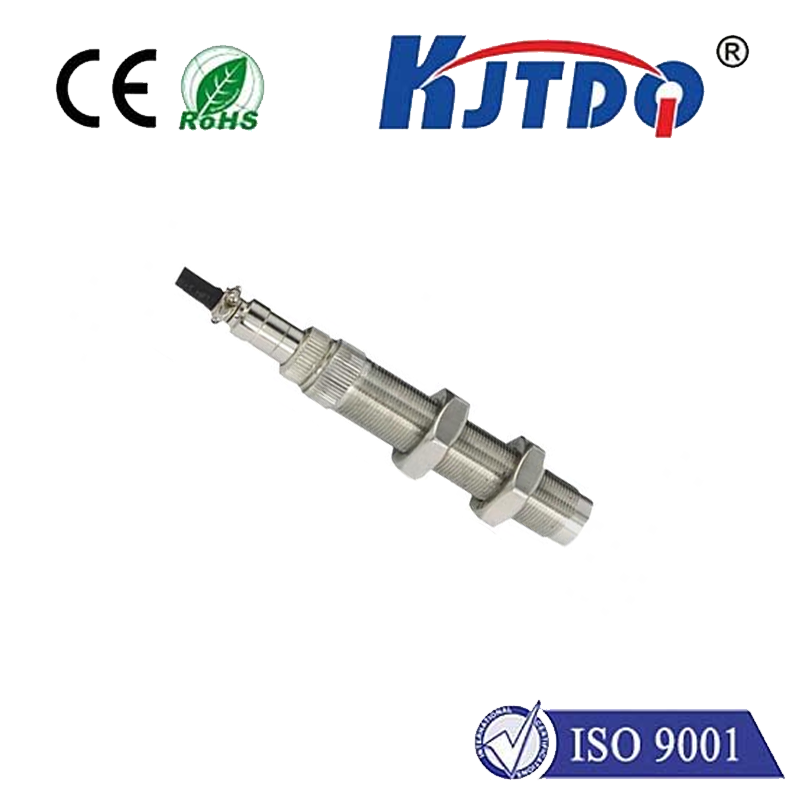
The integration of the KJTDQ series analog laser sensors exemplifies this technology's evolution. Designed for harsh industrial settings, these sensors combine robust construction with stable analog circuitry to deliver a clean, reliable signal even in the presence of electrical noise from motors and drives. Their linearized output ensures that the voltage-to-distance relationship is consistent across the entire range, simplifying calibration and improving measurement fidelity. This reliability makes them a preferred component in systems where downtime is costly, such as automotive production lines or heavy machinery guidance.
Beyond basic distance measurement, the data from these sensors fuels advanced Industry 4.0 initiatives. The continuous analog signal can be digitized and fed into data acquisition systems for trend analysis, predictive maintenance, and process optimization. By monitoring subtle changes in measured distances over time, operators can predict equipment wear (like sagging in conveyors) or detect process anomalies before they lead to defects or stoppages.
In conclusion, the analog output laser rangefinder sensor is far more than a simple measuring device. It is a critical enabler of precision, flexibility, and intelligence in automated systems. Its straightforward analog interface bridges the gap between precise optical measurement and legacy-compatible control architectures, offering a perfect blend of high performance and ease of use. For engineers and system integrators tasked with implementing reliable distance sensing, from basic positioning to complex dynamic control, specifying a high-quality analog laser sensor like the KJTDQ series is a strategic decision that ensures accuracy, robustness, and long-term operational success in the competitive landscape of industrial automation.