check

check

check

check

check

check
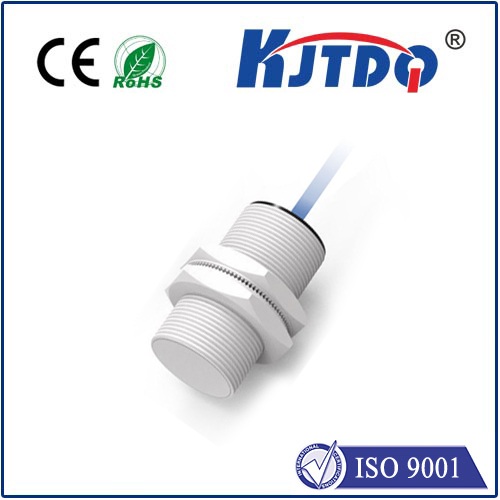
In the intricate world of industrial automation, precision and reliability are not just advantages; they are absolute necessities. The CJF18-05NA proximity sensor stands as a testament to this principle, offering a robust solution for countless detection and positioning tasks. This inductive proximity sensor is engineered to deliver consistent performance in demanding environments, making it a cornerstone component for engineers and system integrators seeking to enhance operational efficiency and machine safety.
At its core, the CJF18-05NA is a non-contact sensing device. It operates on the principle of electromagnetic induction. The sensor generates a high-frequency oscillating electromagnetic field from its active face. When a metallic target, typically steel, aluminum, or brass, enters this detection field, eddy currents are induced on the target's surface. This causes a change in the oscillation amplitude within the sensor, which is then processed by its internal circuitry. This change triggers a solid-state switching output, signaling the presence of the object without any physical contact. This non-contact nature eliminates mechanical wear and tear, ensuring a remarkably long operational lifespan and reducing maintenance costs significantly.
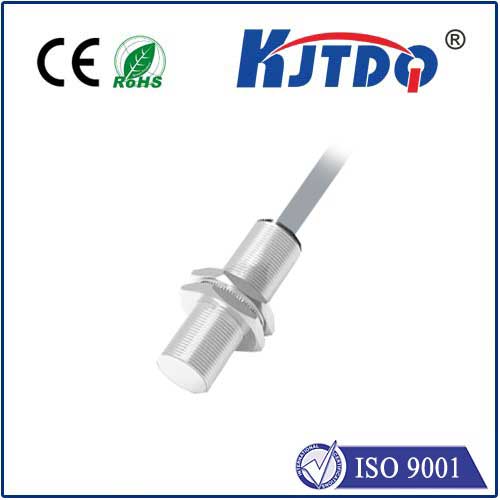
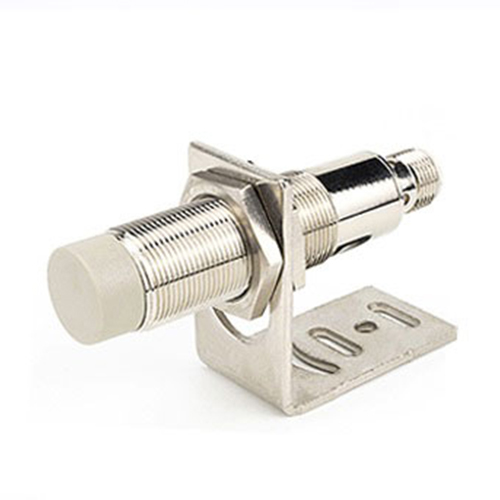
The "18" in its designation refers to its 18mm diameter cylindrical housing, a common and versatile form factor. The "05" indicates a standard sensing distance of 5mm for a defined steel target. This precise specification is crucial for designers to ensure proper installation and gap tolerance. The "NA" suffix typically denotes a normally open (NO) output configuration in DC (PNP) sourcing models, which is a widely used standard. This sensor is designed primarily for DC voltage operation, commonly in 10-30V DC ranges, providing compatibility with standard industrial control systems like PLCs (Programmable Logic Controllers).
The applications for the CJF18-05NA are vast and varied across multiple industries. In automotive manufacturing lines, these sensors are indispensable for detecting the position of metal components on conveyor belts, verifying the presence of engine blocks, or counting parts. Within packaging machinery, they ensure precise positioning of metalized foil or detect the presence of metallic caps on bottles. In material handling and robotics, they are used for end-of-arm tooling detection, verifying gripper positions, or providing limit switching for automated guided vehicles (AGVs). Their sealed construction, often meeting IP67 standards, makes them resistant to dust ingress and temporary water immersion, allowing them to perform reliably in harsh workshop conditions with coolants, oils, and metal shavings.
Selecting and installing the CJF18-05NA requires attention to key details. First, ensure the target material is ferrous or non-ferrous metal, as the sensing distance varies with material type. For instance, the effective range for aluminum or copper is less than that for mild steel. Second, proper mounting is essential. Flush-mounting (embedding the sensor in a metal bracket) reduces the effective sensing range, while non-flush mounting allows the full 5mm range. Always refer to the manufacturer's datasheet for precise mounting instructions and dimensional drawings. Third, consider the electrical load and ensure proper wiring, typically involving a brown wire for DC+, a blue wire for DC-, and a black wire for the switched output signal. Incorporating protective devices like surge suppressors in inductive load circuits is a recommended practice to enhance longevity.
When compared to other sensing technologies like photoelectric or capacitive sensors, the inductive CJF18-05NA excels in environments where the target is metallic and the surroundings are dirty or wet. It is unaffected by color, transparency, or ambient light conditions, providing a stable signal where optical sensors might fail. Its primary limitation is its exclusive sensitivity to metals, making it unsuitable for detecting plastics, wood, or liquids.
For maintenance personnel, troubleshooting is often straightforward. Common issues include no output signal, which can be traced to incorrect power supply, wiring faults, an out-of-range target, or sensor damage. An LED indicator, a standard feature on most models including variants of the CJF18 series, provides immediate visual feedback on the sensor's operational status (power and switching state), greatly simplifying diagnostics.
In conclusion, the CJF18-05NA proximity sensor represents a mature, reliable, and cost-effective technology for industrial metal detection. Its durability, simple integration, and consistent performance under tough conditions have solidified its role as a fundamental building block in modern automation. By understanding its operating principles, specifications, and ideal application scenarios, engineers can leverage this versatile component to build smarter, more efficient, and more reliable automated systems, driving productivity forward in an increasingly competitive manufacturing landscape.