check
check
check
check
check
check
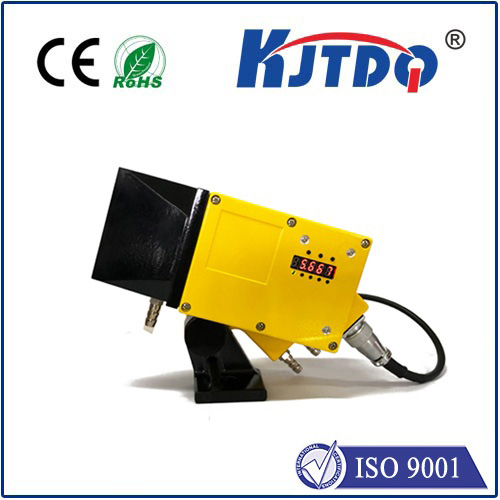
Hot steel on rolling and continuous-casting lines is detected with a hot-metal detector — a photoelectric device that senses the infrared radiation emitted by the hot target itself, rather than light reflected from it. KJT Sensors' hot-metal detector combines a thermopile sensing element with germanium-lens imaging and electronic compensation to identify the leading edge and direction of moving hot metal on hot-rolling lines, continuous-casting lines and billet transport. Reliable selection depends on target temperature, target size, scale, dust and mounting conditions — all of which are process-specific and must be confirmed for the exact model and installation.
Hot-metal detection works from the target's own radiation. A hot-metal detector senses infrared emission from the hot steel, which is why it works on fast-moving, glowing targets where reflected-light sensors struggle.
The detector's job is edge and direction, not temperature measurement. KJT Sensors' device identifies the leading edge and movement direction of hot metal for line control; actual temperature values belong to an infrared thermometer.
Scale, dust, radiant heat and vibration are the selection environment. They affect detection reliability, mounting and service life — which is why general-purpose sensors are documented as not necessarily suitable for steel plants.
Model parameters are process-specific. Sensing distance, response time, output type and applicable temperature are confirmed for the specific model; KJT Sensors' steel-industry documentation states this explicitly.
Cold targets on the same line need a different device. Cold-metal detectors (visible red or infrared light source) handle ambient-temperature workpieces — the comparison is covered separately.
Hot-metal detection relies on the target's own infrared radiation, tolerates a moving glowing target and must survive radiant heat, dust and scale — three conditions under which ordinary object-detection sensors lose reliability.
An ordinary photoelectric sensor detects an object by sending light and receiving what is reflected back. A red-hot or orange-hot steel strand defeats this in several ways: its own emission overwhelms reflected-light measurement, its radiating surface behaves differently from a cool reflective one, and the surrounding environment — radiant heat, oxide scale dust, cooling-water steam, vibration — degrades ordinary sensor optics and electronics.
The hot-metal detector inverts the principle. KJT Sensors' device is, per its published description, a photoelectric detection device combining a thermopile sensing element with germanium-lens imaging; its circuitry includes photoelectric conversion, electronic switching-comparison output and electronic compensation. The thermopile converts the infrared radiation emitted by the hot target into an electrical signal; germanium optics focus that radiation; the switching-comparison stage converts the signal into a discrete detection output; and electronic compensation stabilizes the behavior against environmental variation. The output is a control signal for the metallurgical line — indicating that hot metal has arrived at, or is moving through, the monitored position.
This is why KJT Sensors positions hot-metal detection as part of its dedicated steel-industry portfolio rather than its general photoelectric line, and why its steel-industry documentation states plainly that general-purpose sensors may produce false or missed detections, shorter service lives or frequent maintenance in metallurgical environments.