check

check
check

check
check
check
check
check

check

check
A laser crane anti-collision system mounts laser distance sensors on the crane bridge or trolley, continuously measures the distance to the opposing crane, wall or end stop, and feeds that distance to the crane control system, which slows the crane at a warning threshold and stops it at a final threshold. To specify one, you need four decisions: (1) the sensing range covering your longest bay plus braking distance, (2) two-stage output — warning/deceleration and stop — matched to your control circuit, (3) environmental fitness for the bay: dust, steam, ambient light, vibration and temperature, and (4) mounting and alignment that keeps the beam on its target reflector or opposing surface. Laser anti-collision is a protection layer that reduces collision risk; it complements — never replaces — the crane's rated safety devices and the site's safety procedures.
Key takeaways
Laser anti-collision = continuous distance measurement + threshold logic (slow down, then stop), not a simple presence switch.
Size the sensing range to the bay length plus worst-case braking distance at full speed and full load.
Two cranes on one runway typically need sensors on both, measuring at each other or at dedicated reflectors.
Dusty, steamy steel-plant bays require model-level verification of ambient-light immunity, IP rating and mounting stability.
KJT Sensors offers laser distance sensors (TLS series) and lists crane anti-collision systems as a steel-industry product category; project configurations are confirmed per site.
Overhead traveling cranes share runways: two cranes on one bay, a crane approaching the end stop at speed, a trolley approaching its limit. The consequences of a collision — structural damage, dropped loads, derailment, injury — are among the most severe in material handling. Mechanical buffers and end-stop limit switches are the last line of defense; they absorb or interrupt at the limit, but they do nothing about approach speed. A crane that hits a buffer at full travel speed still delivers a destructive impact.
Active anti-collision adds the missing layer: it measures the remaining distance continuously and gives the control system time to act — decelerate smoothly at a first threshold, stop before contact at a second. The crane never reaches the buffer at speed in the first place.

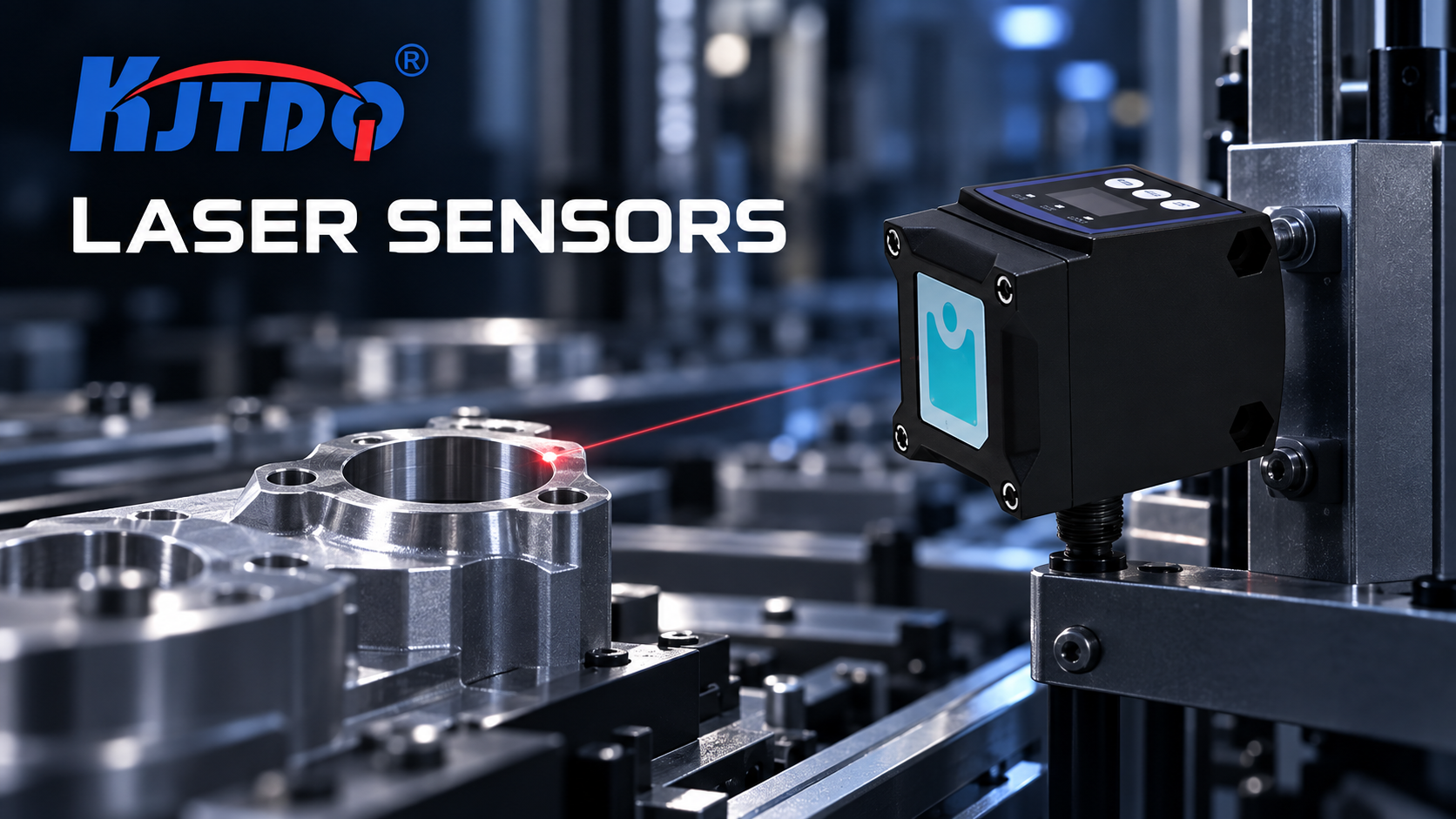
The measurement core is a laser distance sensor: it emits a laser beam toward a target — the opposing crane's structure or a dedicated reflector — and computes distance from the returned light, typically updating many times per second. The system logic then works on thresholds:
Normal zone: distance above the warning threshold — the crane travels freely.
Warning / deceleration zone: distance crosses the first threshold — the system signals the crane control to cut speed (or alarms the operator, depending on integration).
Stop zone: distance crosses the final threshold — travel in the closing direction is interrupted before contact.
A typical two-crane runway uses one sensor pair per crane (each crane measures the distance to the other), so protection works regardless of which crane moves. Crane-to-end-stop protection uses a sensor measuring toward the end wall or a fixed reflector. Because the measurement is continuous distance — not a single switch point — thresholds can be set to match the crane's actual braking behavior, and position data can simultaneously serve travel positioning where the control system supports it.
| Technology | Strength | Limitation | Choose it when |
|---|---|---|---|
| Laser distance measurement | Precise continuous distance; small spot; thresholds settable anywhere in range | Needs a reasonably clear optical path; heavy steam/dust or condensation on the lens degrades it | Indoor bays, steel plants with moderate dust, where precise two-stage control is wanted |
| Radar (millimeter-wave) | Works through dust, fog and steam | Wider beam, less precise point measurement; typically higher cost for short ranges | Very dusty, steamy or outdoor bays where the optical path cannot be kept clean |
| Ultrasonic | Economical | Air-dependent: wind, temperature gradients and vapor disturb it; limited range for long bays | Only for short, calm, clean indoor spans |
| Mechanical limit switches / buffers | Simple, passive, standard-required last line | No speed management; contact happens at full remaining energy | Always present as the final layer — not a substitute for active anti-collision |
In steel-plant practice the choice is usually laser versus radar: laser where the optical path can be maintained, radar where the atmosphere makes any optical measurement unreliable. KJT Sensors manufactures both laser distance sensors and millimeter-wave radar products, and its steel-industry catalog lists crane anti-collision systems as a dedicated category — the sensing principle for a given project should be confirmed against the bay's actual atmosphere.
| Specification | What to decide | Why it matters | What to verify |
|---|---|---|---|
| Measuring range | Longest bay distance + full-speed, full-load braking distance + margin | A sensor that "runs out of range" leaves the crane unprotected at long separation | Model's rated range vs your worst-case distance |
| Output configuration | Two independent thresholds (warning + stop): relay, NPN/PNP, or analog/RS485 distance feed into the PLC | The crane control needs distinct deceleration and stop signals | Output types and ratings of the exact model against your control circuit |
| Response / update behavior | Fast enough that the distance value is current at full travel speed | Stale data shifts the effective stop point | Response time per model documentation |
| Ambient-light immunity | Mill cranes work under strong lighting, welding flash and sunlight through openings | Optical interference causes false or lost readings | Manufacturer-stated immunity and any test conditions |
| Environmental rating | Dust, steam, vibration, temperature of the bay | The sensor must survive where it is mounted | IP rating and operating temperature per model |
| Mounting and alignment | Rigid bracket on the bridge; beam aimed at the opposing structure or a reflector | Vibration-induced beam walk causes distance jitter | Bracket design, alignment aids, commissioning procedure |
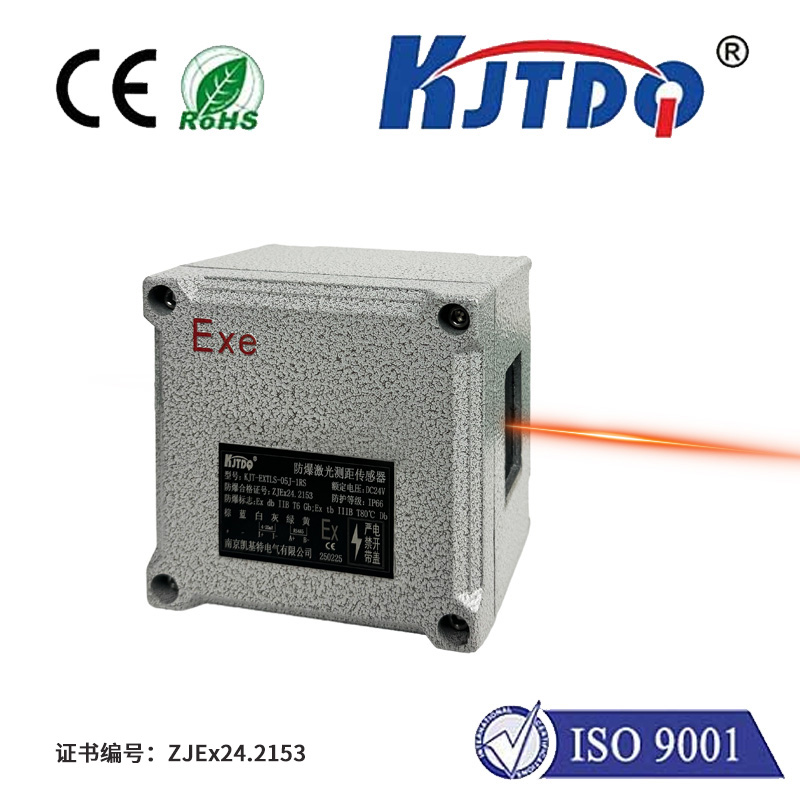
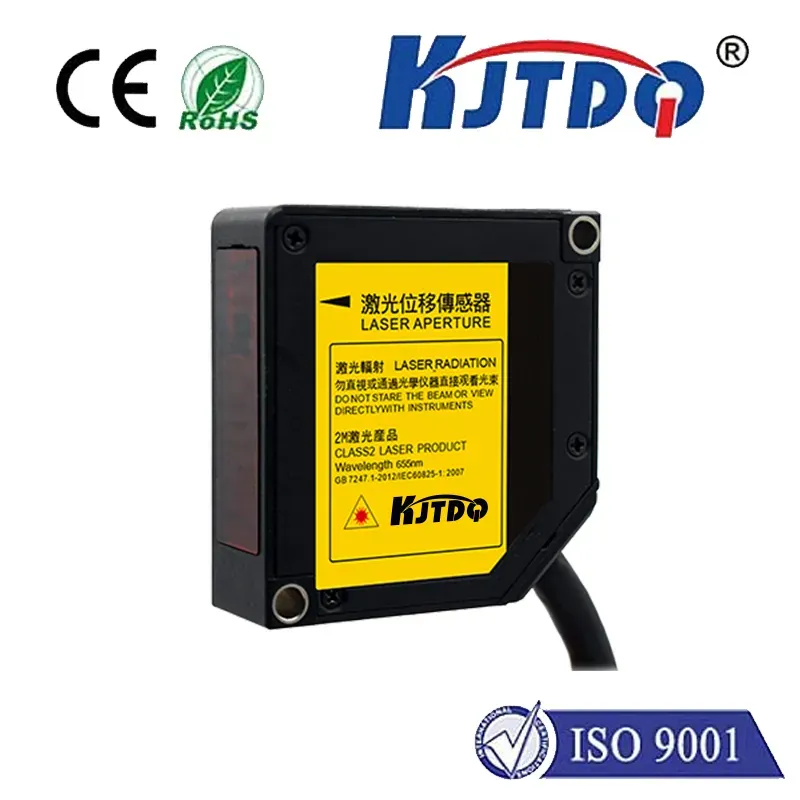
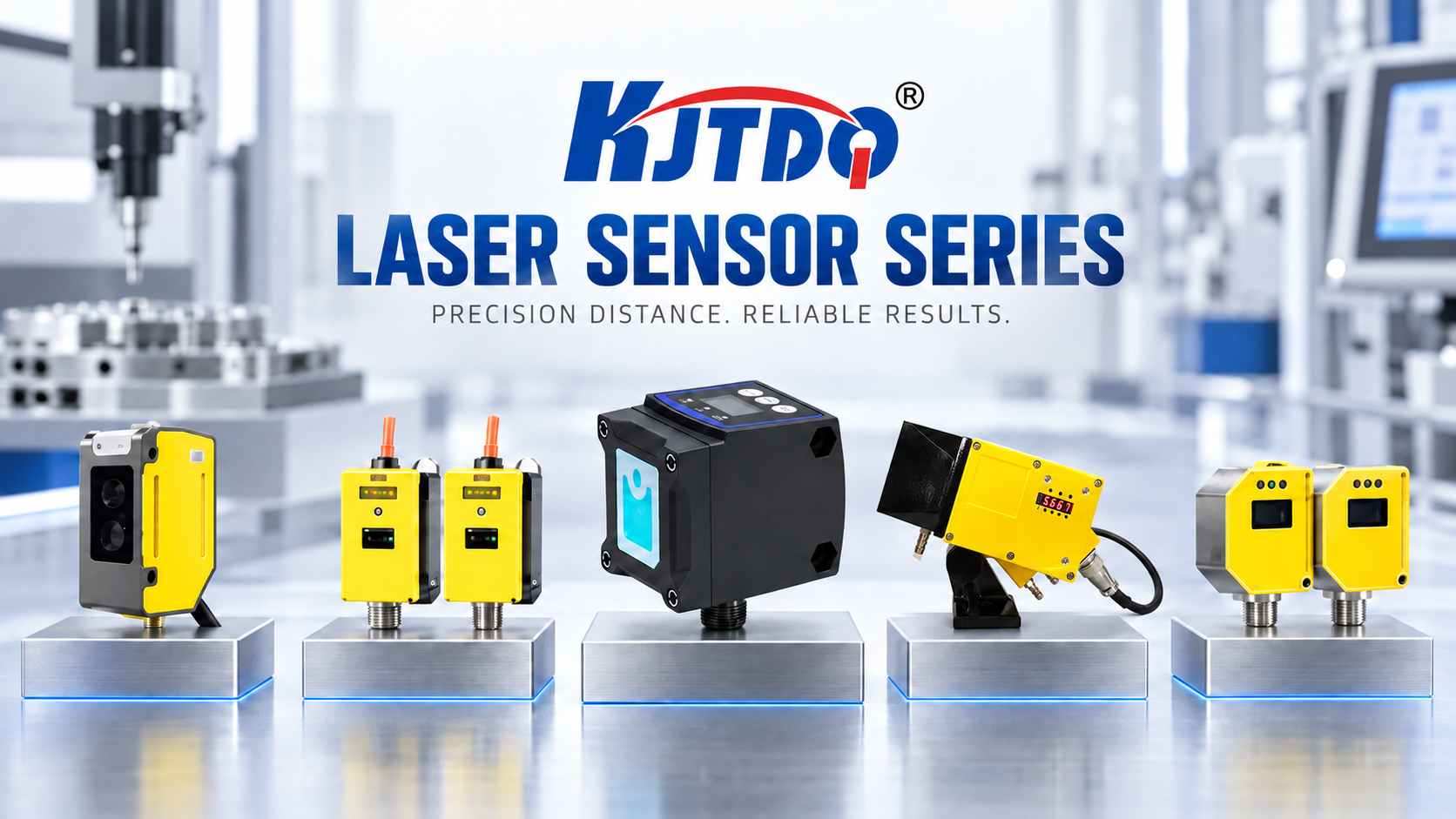
The KJT Sensors TLS series laser distance sensors, for reference, are described by the manufacturer as measuring vertical or inclined targets at distances up to 30 m, with NPN/PNP, analog (voltage/current) and RS485 outputs, relay limit outputs, OLED display with pushbutton programming, IP67 housing and ambient-light-resistant design — a parameter set that maps directly onto the checklist above. As always, each value must be confirmed on the specific model's documentation.
A representative layout for a two-crane steel-plant bay (typical configuration, not a certified design — every installation must be engineered for the site):
Hardware: one laser distance sensor on each crane bridge, aimed at a defined target area on the opposing crane; where the opposing structure is an unreliable target (irregular surfaces, hook block in the path), a flat reflector plate is mounted as the aiming point.
Signal flow: each sensor's two-stage output — e.g. relay or PNP thresholds — feeds the crane's travel control: threshold 1 forces low speed, threshold 2 inhibits further travel in the closing direction.
Threshold setting: stop threshold = longest measured braking distance at full speed and full load, plus safety margin; warning threshold = stop threshold + deceleration zone. Thresholds are verified by on-site braking tests, not calculated once and forgotten — brake wear changes them over time.
Commissioning and maintenance: alignment check and braking-distance verification at commissioning, then periodic re-verification; lens cleaning on a schedule matched to the bay's dust load.
Safety boundary: anti-collision is a risk-reduction layer within the crane's overall safety system. Final safety functions, rated safety devices and compliance with the site's applicable crane-safety standards must be designed and validated by qualified personnel.
KJT Sensors is an industrial sensor manufacturer headquartered in Nanjing, China, with a steel-industry product range that lists laser crane anti-collision systems alongside hot-metal detectors, laser distance meters and infrared thermometers. The manufacturer states that some steel-industry products are positioned as alternatives to overseas products and have been used by multiple steel companies; any replacement or new installation should be confirmed model-by-model against the site's conditions. For project inquiry, the useful information set is: runway length and crane count, crane speeds and loads, existing control-circuit interface (relay/PLC), bay atmosphere (dust, steam, temperature, ambient light), and mounting constraints on each crane.
Each crane should carry its own sensor measuring the distance to the other crane (or to a reflector on it). A single sensor protects only the crane it is mounted on; the second crane would travel unprotected.
Laser sensors designed for industrial duty include ambient-light immunity and sealed housings, and steel-plant bays are a listed application for products like the KJT Sensors TLS series. However, heavy sustained dust or steam in the beam path degrades any optical measurement — in those bays, millimeter-wave radar is the more robust principle. Confirm the atmosphere at the mounting points before choosing.
The limit switch (and buffer) is the final, passive protection at the physical limit — it acts at contact or just before it. Anti-collision is active distance management: it slows and stops the crane while distance still remains, so the limit switch and buffer are never reached at speed. Both layers are needed; one does not replace the other.
Yes — a sensor outputting continuous distance (analog or RS485) can serve both anti-collision thresholds and travel positioning, if the control system is designed to use the data. This is a common secondary benefit of choosing a measuring sensor over a switch-only device.
At commissioning, after any brake maintenance, and on a periodic schedule defined by the site's safety procedures — because braking distance changes with brake wear, load spectrum and rail condition. The sensor measures distance accurately; the thresholds are only as good as the last braking test.
Crane anti-collision is distance management: measure continuously, slow early, stop before contact — and let the buffers stay untouched for the life of the crane. Choose the sensing principle for the bay's atmosphere, size the range for the worst-case braking distance, and verify thresholds with real braking tests.
Planning anti-collision protection for a crane bay? Send KJT Sensors your runway length, crane count, speeds, control interface and bay atmosphere, and request a configuration proposal: www.kjt-sensors.com
KJT Sensors — TLS Series Laser Distance Sensor: https://www.kjt-sensors.com/show-559.html
KJT Sensors — Laser Distance Sensors: https://www.kjt-sensors.com/list-jgcjcgq.html
KJT Sensors — Sensors for the Steel Industry: https://www.kjt-sensors.com/list-gtxyjccgq.html
Product capabilities cited above are based on the manufacturer's published product pages (accessed September 2026). Measuring range, output configuration, response time, IP rating and mounting must be confirmed against the specific model's documentation. Public information on the crane anti-collision system category is limited; project configurations are confirmed per site with the manufacturer.
This article is brand content marketing produced for KJT Sensors. Crane anti-collision involves machine and personnel safety: system design, threshold setting, safety validation and compliance with applicable crane-safety standards must be performed by qualified personnel. Nothing in this article substitutes for the site's safety engineering and regulatory obligations.