check
check

check

check
check
check
check
check

check

check
<!-- x-tinymce/html -->
A hot metal detector (HMD) identifies hot steel — typically billets, slabs, bars or strip at several hundred degrees Celsius and above — by sensing the infrared radiation the workpiece itself emits, not by bouncing a light beam off it. For rolling-mill and continuous-casting duty, choose a detector by four things: (1) the target temperature range and minimum detectable temperature, (2) the installation distance and viewing geometry relative to the line, (3) immunity to the mill environment — scale, steam, water spray, dust and intense ambient light, and (4) the output interface your control system expects. Where cold workpieces must also be detected on the same line, use a cold-metal detector or a combined hot/cold-metal detector instead. All sensing distance, response time, output and temperature specifications must be confirmed against the specific model's documentation.

Key takeaways
A hot metal detector is a passive infrared device: it reads the target's own heat radiation, so it works regardless of surface color, scale or ambient light — within its rated temperature and distance limits.
Standard inductive proximity sensors and ordinary photoelectric sensors are not designed for hot-metal duty; heat, steam and scale destroy or blind them.
Hot-metal, cold-metal and combined hot/cold-metal detectors answer different detection tasks on the same line; match the device to the workpiece temperature at each detection point.
KJT Sensors manufactures hot-metal, cold-metal and combined hot/cold-metal detectors as part of a steel-industry range covering level, displacement, temperature and crane anti-collision detection.
A hot metal detector is a photoelectric detection device that identifies the presence, leading edge and movement direction of hot metal on a production line. Unlike a standard photoelectric sensor, it carries no light source aimed at the target. Instead, it collects the infrared energy that the hot workpiece radiates by itself.
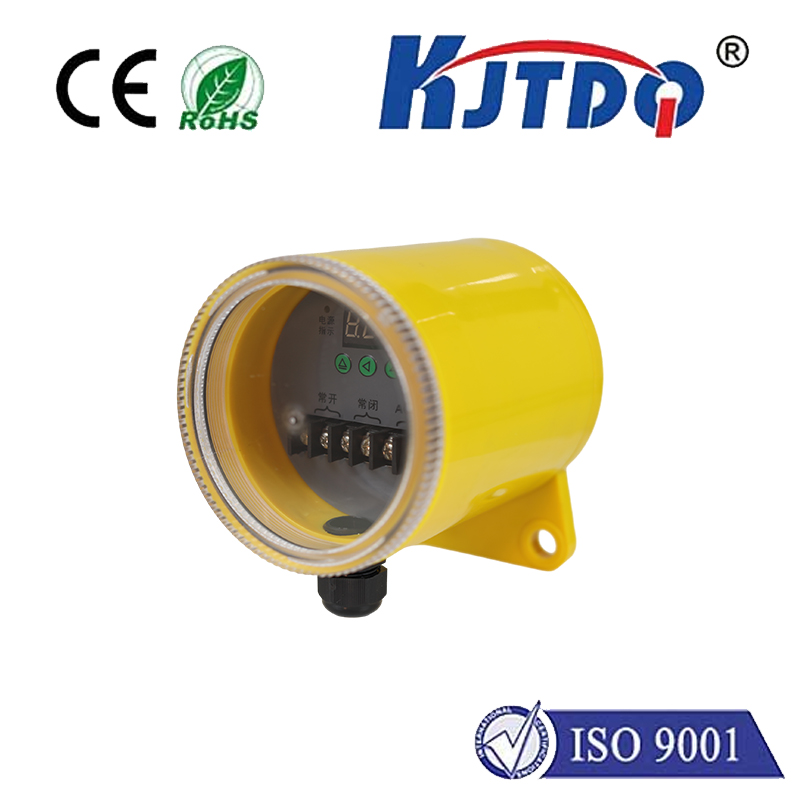
The KJT Sensors hot-metal detector, according to the manufacturer's published product information, combines a thermopile sensing element with germanium-lens imaging: the germanium lens focuses infrared radiation onto the thermopile, and the detector's circuitry — photoelectric conversion, an electronic switching-comparison output stage and electronic compensation — turns that radiation into a clean switching signal for the line's control system. Because the detected quantity is the target's own heat, the signal does not depend on how reflective the surface is, whether it is covered in scale, or how bright the mill lighting is.
Typical detection content is presence, leading edge and direction of movement — the signals a rolling line needs to trigger crop shears, control roller tables, sequence descaling sprays and interlock downstream equipment.
This is the question maintenance engineers ask after the first failed substitution attempt, and the answer has three parts:
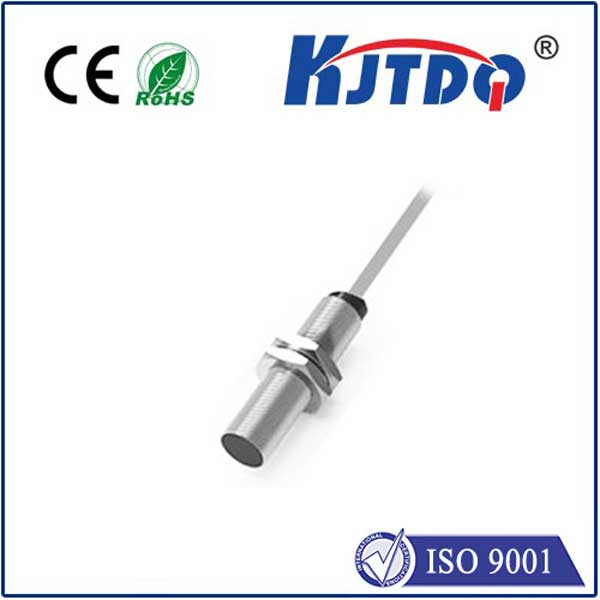
Temperature. An inductive proximity sensor mounted close enough to sense a billet sits in radiant heat far beyond its rated operating range. Electronics drift, then fail; housings, cables and sensing faces degrade. Even high-temperature proximity models have defined limits that must be verified per model — and proximity sensing distances (millimeters to tens of millimeters) force the sensor dangerously close to the hot target in the first place.
The target problem. A standard photoelectric sensor works by emitting light and reading what comes back. Hot steel emits its own strong infrared radiation, which floods the receiver; scale, steam and water spray scatter and absorb the emitted beam; surface reflectivity changes with temperature and oxidation. The result is false triggering or missed detection — the two things a rolling line cannot tolerate.
The environment. Mills add dust, vibration, steam clouds and intense ambient light. General-purpose sensors are not sealed, compensated or optically filtered for this combination.
A hot metal detector is engineered around exactly these three problems: it reads the target's own radiation (no emitted beam to scatter), works from a practical standoff distance, and uses optical filtering and electronic compensation to reject ambient interference. The conclusion is not that one sensor type is "better" — it is that hot-metal detection is a different measurement task, and it needs a device built for that task.
The workpiece temperature at the detection point decides the device:
Hot-metal detector: for workpieces hot enough to radiate detectable infrared — hot-rolling lines, continuous casting, transfer of hot billets and slabs, high-temperature workstations. It identifies hot-metal presence, position and movement direction.
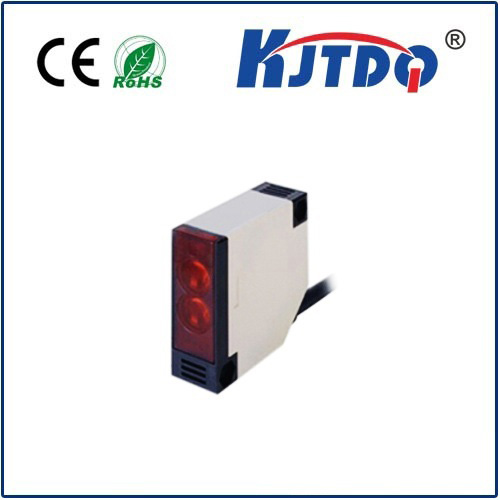
Cold-metal detector: for workpieces at or near ambient temperature — cooling beds, discharge points, conveyor lines after cooling. Because cold metal radiates no useful infrared, a cold-metal detector works like an industrial photoelectric device with an active light source: the KJT Sensors cold-metal detector, for example, offers visible red or infrared light sources and retro-reflective, through-beam or diffuse-reflective configurations, and outputs a switching signal when the workpiece reaches the required position.
Combined hot/cold-metal detector: for lines that must detect workpieces at different temperature stages with one installed base — the KJT Sensors range lists combined hot/cold-metal detectors as a distinct category for exactly this situation.
The practical rule: walk the line, note the workpiece temperature at every planned detection point, and assign the detector type per point — not per line. A single rolling installation commonly uses all three.
| Specification | What it means | Why it matters | What to verify |
|---|---|---|---|
| Minimum detectable target temperature | The lowest workpiece temperature the detector can reliably identify | A cooling workpiece eventually falls below the threshold and "disappears" | The threshold for the exact model, against your coolest target at the detection point |
| Sensing distance / viewing geometry | How far the detector can be mounted from the target, and its field of view | Determines mounting position relative to roller tables, guides and spray zones | Rated distance and field of view on the model's documentation; required standoff on site |
| Response time | Input change to output response | Fast lines need the leading-edge signal before the workpiece reaches the next actuator | Response time of the specific model against line speed |
| Output / interface | Relay, transistor or other switching output to the control system | Must match the PLC input and control-circuit design | Output type, ratings and wiring per model |
| Environmental protection | Sealing against dust, steam and water; operating temperature of the device itself | The detector's own survival in the mill atmosphere | IP rating and device temperature rating per model; mounting and air-purge accessories if offered |
Values for each of these must come from the specific model's data — do not infer them from the product family or from another model in the same series.
Before committing to a model, request evidence rather than adjectives:
The exact model's data sheet or manual: minimum target temperature, sensing distance, field of view, response time, output configuration and device temperature rating.
Application fit in writing: describe your detection point — workpiece type and temperature, standoff distance, line speed, steam/spray exposure — and ask for a written model recommendation against it.
Certificates and test documents where compliance matters: for export projects or regulated sites, ask which documents exist for the exact model, not the product family.
Replacement cross-reference: if you are replacing an installed imported detector, provide the existing model, mounting dimensions, supply voltage and output type, and ask for a cross-reference confirmation.
Field-adjustment procedure: how sensitivity or switching threshold is set and compensated on site, and what mounting/alignment accessories exist.
KJT Sensors is an industrial sensor manufacturer headquartered in Nanjing, China, with a steel-industry range of more than ten series covering hot-metal detectors, cold-metal detectors, combined hot/cold-metal detectors, laser molten-steel and molten-aluminum level sensors, laser distance meters, displacement detectors, infrared thermometers, laser crane anti-collision systems and billet surface-defect inspection systems. According to the manufacturer's published information, several of these product categories are positioned as alternatives to overseas products and have been used by multiple steel companies; equivalence for any specific replacement must be confirmed for the model and field conditions, not assumed.
The hot-metal detector line targets hot-rolling lines, continuous-casting and rolling automation, billet movement-direction detection and high-temperature workstations. For project quotations, the useful information to prepare is: target type and temperature at each detection point, required standoff distance, line speed, output/interface requirements, environmental conditions and quantity.
It detects the infrared radiation emitted by hot metal and converts it into a switching signal. Practically, it reports hot-metal presence, leading edge and movement direction — for example, to trigger a shear when the head of a hot billet arrives.
HMDs are designed for mill atmospheres including steam and spray, and their passive infrared principle is inherently less sensitive to scattered-light problems than active photoelectric devices. However, heavy steam or water between the detector and the target attenuates infrared too, so mounting position, standoff and any air-purge accessories should be confirmed against the specific model's guidance and the site's conditions.
Every model has a minimum detectable target temperature; below it the workpiece becomes invisible to the detector. This threshold is a model-level specification — verify it against the coolest workpiece the detection point will ever see, and use a cold-metal or combined detector at points where the steel has cooled below the threshold.
Usually not. Detection points at different temperature stages need different devices: hot-metal detectors while the steel radiates enough infrared, cold-metal detectors on cooling beds and after cooling, and combined hot/cold-metal detectors where one position must handle both states.
The manufacturer's steel-industry pages identify several product categories as possible replacements for overseas products, and KJT Sensors supports cross-referencing against installed models. Equivalence — sensing distance, temperature threshold, output, mounting and environmental rating — must be confirmed for the specific model against your field conditions before substitution.
Hot-metal detection is not ordinary object detection in a hotter room — it is a different measurement that uses the target's own radiation as the signal. Choose the detector by the workpiece temperature at each point, verify the model's threshold and distance on paper, and let the hot steel announce itself.
Planning detection points on a rolling or casting line? Send KJT Sensors your workpiece type, temperature range, standoff distance and line speed for each point, and request a model recommendation: www.kjt-sensors.com
KJT Sensors — Hot-Metal Detectors product page: https://www.kjt-sensors.com/list-rjsjcq.html
KJT Sensors — Cold-Metal Detectors product page: https://www.kjt-sensors.com/list-ljsjcq.html
KJT Sensors — Sensors for the Steel Industry: https://www.kjt-sensors.com/list-gtxyjccgq.html