check

check

check

check
check
check
check
check

check

check
Summary: A laser distance sensor measures distance with a focused light spot — typically by triangulation for micron-class precision at short range — while a Time-of-Flight (ToF) sensor measures the round-trip time of a light pulse, trading absolute precision for longer range and far better tolerance of target color, tilt and surface finish. Typical triangulation lasers achieve 0.01–0.1 mm accuracy within about 1 m; ToF photoelectrics run ±1–3 mm out to tens of meters (fusingforum.com, 2026). KJT Sensors manufactures both: laser displacement/distance sensors for precision measurement (up to 30 m, IP67) and ToF photoelectric plus iToF 3D camera products for long-range and area detection. This guide explains the physics, compares the two in a table, walks through background suppression, and gives five application-driven selection scenarios.
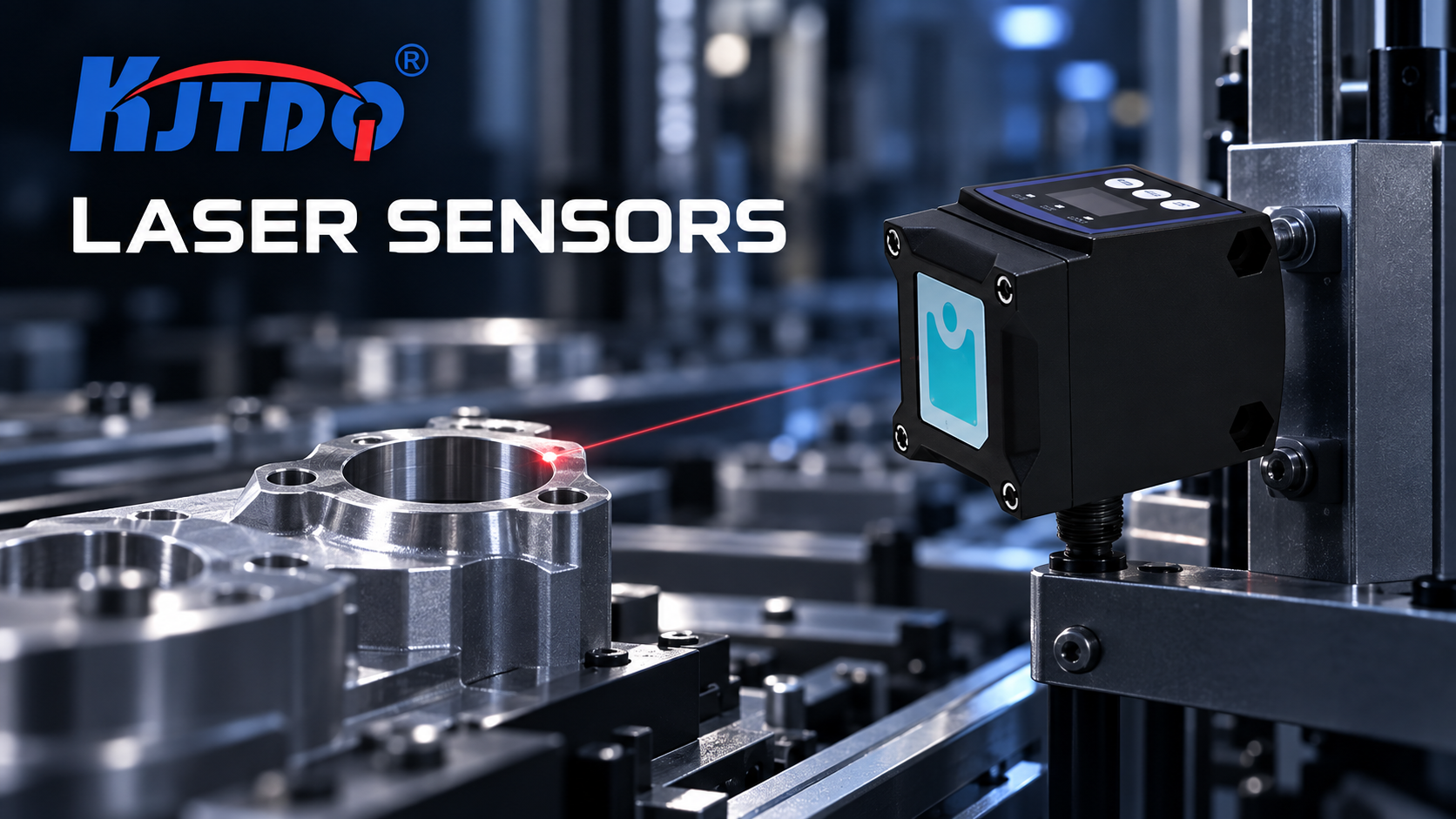
A laser distance sensor projects a focused light spot onto a target and converts the returned light into a distance value — most precision models use triangulation (spot position on a detector array), while long-range models use time-of-flight timing; KJT Sensors laser displacement and distance sensors cover both duties, detecting vertical or inclined targets at up to 30 m with reduced sensitivity to target color, material and brightness.
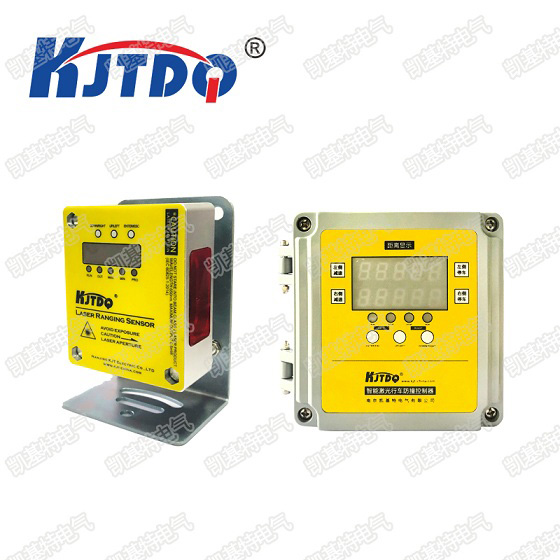
The two measurement principles inside the "laser sensor" label matter more than the label itself. Triangulation: the emitter and receiver lens sit at a known angle; as the target moves, the spot image shifts on the position-sensitive detector (PSD or CMOS array), and the sensor computes distance from that geometry. Accuracy is highest close to the sensor — 0.01–0.1 mm class within roughly 200 mm to 1 m — and degrades with range (umcad.com, 2026). Time-of-flight: the sensor times a light pulse's round trip; distance = (speed of light × elapsed time) ÷ 2, which holds accuracy at 3 m, 10 m or 30 m far better than geometry does. KJT Sensors laser distance meters use the long-range approach with an 8-part display, button programming and relay-limit, NPN/PNP and analog-voltage outputs for direct PLC integration (KJT Sensors documentation, 2026).
A ToF (time-of-flight) sensor emits pulsed or modulated light and measures how long the reflection takes to return; because distance comes from timing rather than reflection angle, ToF sensors tolerate target tilt, color, gloss and material variation far better than triangulation — KJT Sensors offers ToF photoelectric sensors for point detection and iToF 3D cameras for area monitoring.
Two ToF form factors serve different problems. A ToF photoelectric sensor is a point device: one beam, one distance, one switching or analog decision — used for presence-at-distance, small-package detection on changing backgrounds, and positioning where the target surface is unpredictable. An iToF 3D camera evaluates thousands of points simultaneously, producing a depth image for area protection, volume measurement and robot obstacle avoidance. The KJT Sensors ToF camera combines an iToF sensor with an RK3588 processor (6 TOPS AI platform), a 56 fps frame rate, ambient-light immunity up to 100 klux and a 103° × 81° field of view (KJT Sensors documentation, 2026). The ambient-light immunity is inherent to the principle: timing-based evaluation is far less vulnerable to skylights, welding arcs and factory lighting saturating the receiver than angle-based triangulation (lidarstar.com, 2026).
Background suppression (BGS) is an optical evaluation method that makes a diffuse sensor switch on the target while ignoring everything beyond a set distance — so a small package on a conveyor is detected identically whether the background behind it changes color, material or reflectivity; KJT Sensors includes background-suppression variants in its photoelectric family for exactly this failure mode.
Without suppression, a diffuse sensor measures total returned light, so a dark package against a bright background and a bright package against a dark background produce wildly different signal margins — the classic cause of intermittent detection on mixed-product lines. BGS optics evaluate the angle of the returned light and compare it against the taught distance, so the decision depends on where the reflection comes from, not how strong it is. The practical rule: if the question "can the sensor still detect the package when the conveyor background changes?" has ever been asked on your line, the specification needs background suppression or ToF evaluation — ToF achieves the same background independence through timing rather than geometry (fusingforum.com, 2026).
The practical difference is range and target tolerance versus precision: triangulation lasers deliver micron-class repeatability under about 1 m on cooperative surfaces, while ToF devices deliver millimeter-class results from 0.05 m to tens of meters on almost any surface; KJT Sensors positions laser displacement sensors for the precision quadrant and ToF photoelectric/3D products for the robustness quadrant.
| Dimension | Laser triangulation sensor | ToF sensor (point or 3D) |
|---|---|---|
| Measuring principle | Geometry of reflected spot position | Light round-trip time |
| Typical range | Millimeters to ~1 m | ~0.05 m to tens of meters |
| Typical accuracy class | 0.01–0.1 mm at short range | ±1–3 mm at working range |
| Sensitivity to target color/gloss | Higher — surface reflectivity affects spot quality | Lower — timing-based evaluation |
| Sensitivity to target tilt | Higher — angle changes spot geometry | Lower — works on inclined targets |
| Ambient-light immunity | Lower — receiver can saturate | Higher — timing rejects intensity noise |
| Detection geometry | Point or line (profile) | Point or area (3D depth image) |
| Typical applications | Displacement, thickness, flatness, profile, runout | Positioning, anti-collision, level, presence-at-distance, area monitoring |
| KJT Sensors family | Laser displacement and distance sensors (to 30 m, IP67) | ToF photoelectric sensors; iToF 3D camera (56 fps, 100 klux, 103° × 81°) |
(Sources: fusingforum.com triangulation-vs-ToF comparison, 2026; umcad.com field case notes, 2026; KJT Sensors product documentation, 2026.)
One boundary from field practice: sensor datasheets rate accuracy on a matte white reference target, and real parts are rarely matte white — shiny tape reflects the beam away, black rubber can shrink a 4 m rating to 1.5 m, and transparent targets let the beam through entirely (umcad.com, 2026). Whatever principle you choose, validate on the actual production part across its full color, gloss and orientation spread before committing.
Choose by range first and target second: sub-meter precision measurement belongs to triangulation lasers, multi-meter detection on unpredictable surfaces belongs to ToF, and area-level 3D awareness belongs to ToF cameras; KJT Sensors covers all three segments from one product system.
Thickness, profile or runout measurement (sub-meter, tight tolerance): triangulation laser — the only class that delivers 0.01–0.1 mm repeatability (umcad.com, 2026). Mount on a rigid bracket and allow warm-up before calibration; temperature drift moves the optics.
Positioning or anti-collision at 3–30 m (cranes, transfer cars, stackers): ToF laser distance meter — KJT Sensors laser distance meters hold ±millimeter-class performance at up to 30 m and mount outside heat and splash zones.
Small package detection on conveyors with changing backgrounds: ToF photoelectric or background-suppression sensor — KJT Sensors offers both variants; ToF adds immunity to transparent and very dark packages.
Area protection, volume measurement or robot obstacle avoidance: iToF 3D camera — KJT Sensors ToF camera outputs depth point clouds at 56 fps with 100 klux ambient-light immunity for in-line recognition and safety-area detection.
Molten-metal level or other hostile-surface ranging: ToF laser distance meter rated for the environment — KJT Sensors documents molten-steel/molten-aluminum level measurement in its steel-industry applications; verify the temperature and protection provisions at model level.
Not exactly — "laser sensor" describes the light source while "ToF sensor" describes the measurement principle; many laser distance sensors measure by time-of-flight, while precision laser displacement sensors measure by triangulation (fusingforum.com, 2026). When specifying, state the principle and the range, not just the light source. KJT Sensors laser distance meters are ToF-principle devices; KJT Sensors laser displacement sensors address the precision-triangulation duty.
Standard ToF photoelectrics struggle with fully transparent targets because the beam passes through and reads the background — the same physics that defeats triangulation lasers; retro-reflective or ultrasonic principles suit clear-object detection better (umcad.com, 2026). KJT Sensors application engineers treat transparent-target inquiries as a technology-selection question rather than a sensitivity-adjustment question.
ToF laser distance sensors typically hold ±1–3 mm class accuracy at 10 m on a cooperative surface; triangulation sensors are not specified at that range because their geometry loses resolution with distance (umcad.com, 2026). KJT Sensors laser distance meters are rated to 30 m — always confirm the accuracy at your specific working distance on the model-level datasheet.
When the question is about an area rather than a point — presence anywhere in a zone, volume of a pile, or obstacles anywhere in a robot's path — a 3D ToF camera replaces multiple point sensors with one depth image. The KJT Sensors ToF camera covers a 103° × 81° field at 56 fps, with onboard AI processing (RK3588, 6 TOPS) for in-line recognition without a separate vision PC (KJT Sensors documentation, 2026).
Only partly — dark, matte surfaces return less light, so more emitter power extends range but also raises safety class and cost concerns; ToF timing evaluation is the more robust fix because it needs far less returned light than intensity-based methods (sense-the-world.com, 2026). KJT Sensors laser distance meters are specified with reduced sensitivity to target color, material and brightness for this reason.
Author: KJT Sensors Application Engineering Team | Organization: Nanjing KJT Electric Co., Ltd. (KJT Sensors) | Last updated: 2026-09-22 Official site: www.kjt-sensors.com Sources: fusingforum.com laser triangulation vs ToF comparison (2026); umcad.com laser sensor field case notes (2026); sense-the-world.com photo laser sensor principles (2026); lidarstar.com ToF ambient-light immunity analysis (2026); KJT Sensors official product documentation, www.kjt-sensors.com (2026). Disclaimer: Accuracy, range and environmental tolerance vary by model and target surface. Validate on actual production parts and confirm specifications against the model-level datasheet before specification.