check

check

check

check
check
check
check
check

check

check

Limited space, tiny workpieces, and high response requirements? This time, hand the detection point over to a smaller, faster, and more stable solution.
As automation equipment becomes increasingly compact, sensors often face the problems of “not fitting, not seeing accurately, and responding too slowly.” The KJT ultra-miniature laser photoelectric switch uses a miniaturized structure to enter narrow spaces and completes reliable detection with a stable light spot, providing more flexible detection options for precision manufacturing, electronic assembly, equipment integration, and high-speed production lines.
It is small, but not weak. It is slim, but stable enough. When detection space is compressed to the millimeter level, the true test lies in the sensor’s structural design, response speed, and on-site adaptability.
As automation equipment becomes more compact, detection points cannot be compromised. The KJT ultra-miniature laser photoelectric switch enters narrow positions with its small body and completes precise sensing with a stable light spot. It is suitable for sites with limited installation space, small workpiece size, and high detection rhythm requirements, allowing equipment to maintain reliable detection even in limited space.
Keywords: intelligent chip, tensile-resistant wire, multiple protection.
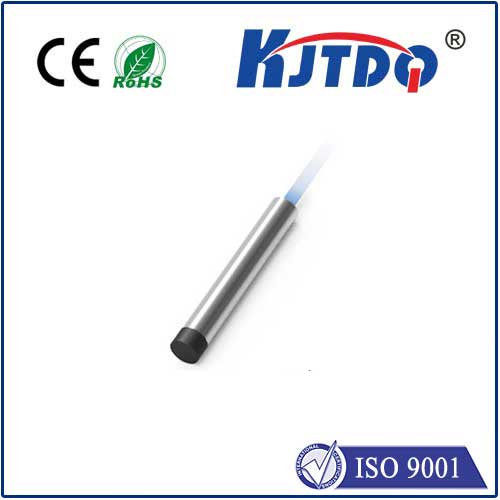
With a probe diameter as small as approximately 3 mm, the sensor can more easily enter small holes, narrow gaps, and compact mechanisms. The NPN/PNP three-wire normally open output makes it easy to connect to automation control systems. Strong anti-interference capability, sensitive sensing, and stable performance allow this “small-size” sensor to meet real industrial-site requirements.
Keywords: 3 mm, NPN/PNP, anti-interference, sensitive and stable.
Ultra-miniature does not simply mean making something smaller. It is the overall optimization of structure, connector, optics, and cable. Multiple connector types are available, making installation more flexible. Strong anti-interference and stable detection performance help reduce repeated debugging on site and make equipment integration easier.
Keywords: easy installation, strong anti-interference, precise and stable.
On-site stability often comes from invisible details. Thickened pure copper conductors improve connection reliability, while clear wire colors make fast identification and maintenance easier. For equipment running for long periods, durable cables and stable signals can effectively reduce later maintenance costs.
Keywords: thickened pure copper conductor, clear wiring, durable and reliable.
In actual use, what is usually visible is the detection light spot, not the complete light beam. The beam effect shown on the page is intended to display the detection path and working logic more intuitively. Clear light spot feedback helps on-site personnel complete alignment, debugging, and confirmation more quickly.
Keywords: visible light spot, intuitive debugging, precision machining.
The value of an ultra-miniature structure is best demonstrated in complex installation environments. It can detect targets through small holes, be installed in very small holes and narrow spaces, and detect tiny, slender, or hard-to-observe objects. For precision equipment, this is the practical meaning of “small size.”
Keywords: small-hole detection, narrow space, tiny objects.
The hexagonal through-beam structure combined with simple single-point installation reduces the need for complicated brackets and tedious adjustment. The maximum detection distance can reach 100 mm and can be adjusted according to on-site requirements, making it more flexible for compact equipment, retrofit projects, and multi-station detection.
Keywords: single-point installation, 100 mm, adjustable detection distance.
A maximum detection distance of 100 mm leaves more margin for installation. The fastest 0.1 ms response makes rapid identification, positioning, and counting on high-speed production lines easier. For hard-to-detect workpieces, stable light spots and fast feedback can improve overall line judgment efficiency.
Keywords: 100 mm detection distance, 0.1 ms fast response.
From nut detection and electronic component positioning to drill processing identification and fixture-in-place detection, ultra-miniature laser photoelectric switches can be flexibly applied in different scenarios. The compact structure lowers the installation threshold, while stable output improves detection reliability, allowing more automation details to be accurately captured.
Keywords: multiple scenarios, precision detection, automated production lines.
For automated detection involving small spaces, small targets, and high-speed cycles, a sensor must do more than simply “fit inside.” It must respond quickly, output stable signals, install easily, and adapt strongly to different scenarios. With an approximately 3 mm miniature probe, maximum 100 mm detection distance, fastest 0.1 ms response, and multiple installation application methods, the KJT ultra-miniature laser photoelectric switch provides a more reliable detection choice for precision equipment and automated production lines.