check

check

check

check
check
check
check
check

check

check
<!-- x-tinymce/html -->
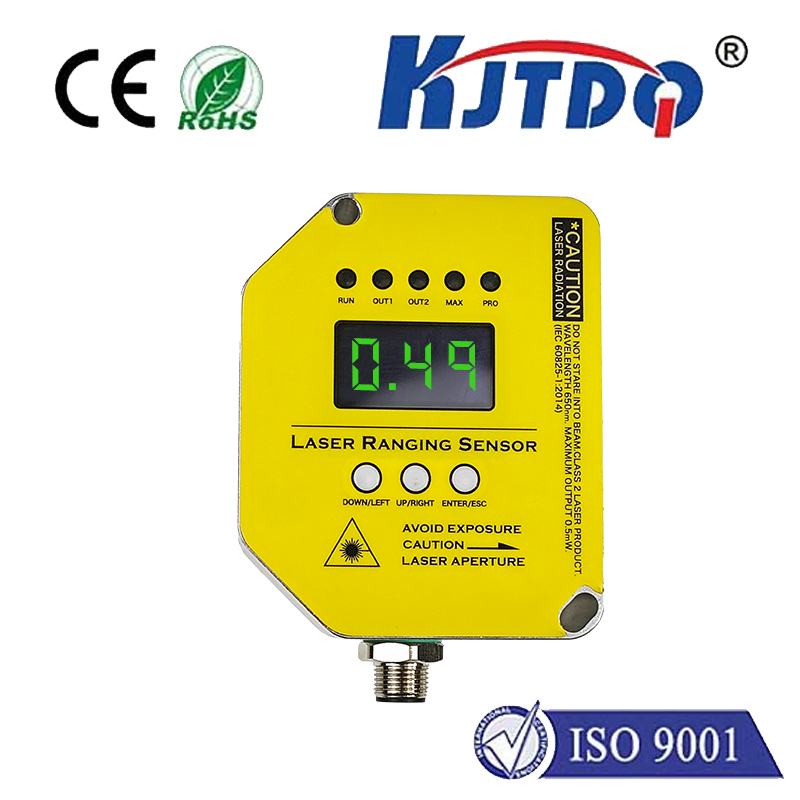
A laser distance sensor measures the distance to a target without contact and converts that measurement into a signal your control system can use — a switching output for position thresholds, or an analog/RS485 output for continuous position feedback. To select one for machine positioning, define the measuring range and the required repeatability first, then check how the target's color, material, and surface finish affect readings, and finally match the output type to the controller. KJT Sensors, the industrial sensor brand of Nanjing KJT Electric Co., Ltd., builds its laser distance portfolio around this sequence, with its TLS series covering positioning, displacement measurement, and collision-avoidance tasks.

A laser distance sensor answers "how far?", not just "present or absent?" — that is what makes it a positioning instrument.
Repeatability matters more than a headline range for positioning; verify it for the specific model under your conditions.
Target color, gloss, and surface texture change readings — test with your real target, including worst-case surfaces.
Choose a switching output for position thresholds and analog or RS485 for continuous position feedback.
A presence sensor tells a machine that something has arrived. A laser distance sensor tells it where something is. That difference opens up tasks that simple detection cannot do:
Position feedback for moving carriages, slides, stacker cranes, and shuttle vehicles;
Displacement measurement on automated lines, including workpiece thickness, roll diameter, and material height;
Collision avoidance for overhead cranes, traveling cranes, and AGV/AMR equipment;
Closed-loop control, where the measured distance continuously drives a process variable.
According to the manufacturer's published product information, KJT Sensors laser distance sensors are applied to storage-location detection in smart warehouses, positioning of stacker cranes and shuttle vehicles, logistics sorting, crane collision avoidance, AGV/AMR obstacle avoidance, displacement measurement, and ranging at steel and metallurgical sites.
The sensor emits a laser beam toward the target and calculates distance from the returned light. Because measurement is non-contact, it suits high-speed targets, long ranges, hot or hazardous areas, and positions that personnel cannot safely approach. Unlike a standard photoelectric switch, the output is not only on/off — distance values can be read continuously, displayed locally, and fed to a PLC, control cabinet, supervisory computer, or safety-monitoring system.
KJT Sensors states that its TLS series can detect vertical or inclined targets at distances up to 30 m on listed models, with reduced influence from target color, material, and gloss; actual performance depends on the target surface, mounting angle, and field environment, and must be confirmed for the specific model.
| Specification | What it means | Why it matters for positioning | What to verify |
|---|---|---|---|
| Measuring range | Minimum to maximum measurable distance | Must cover the full travel of your moving element with margin | Range for the exact model and your target surface |
| Repeatability | Consistency of repeated measurements under identical conditions | Defines how precisely you can return to a position | Repeatability conditions in the data sheet |
| Accuracy | Closeness of the reading to the true distance | Matters when the absolute value drives a process setpoint | Accuracy rating and its reference conditions |
| Resolution | Smallest detectable change in distance | Limits fine position adjustments | Resolution at your working distance |
| Response time / sampling rate | How quickly readings update | Fast-moving machines need fast updates | Model-rated response or sampling specification |
| Output type | Switching, analog, RS485, or relay | Must match how the controller consumes position data | Controller input specification |
| Protection and ambient-light immunity | Environmental robustness of the housing and optics | Dust, water, vibration, and sunlight degrade unprotected optics | IP rating and documented immunity for the exact model |
These terms are not interchangeable — repeatability, accuracy, and resolution answer different questions, and a positioning specification that confuses them leads to the wrong model.
Switching outputs (NPN/PNP, relay) fit threshold-based positioning: "stop when the carriage reaches 2.5 m" or "alarm when the crane is within 3 m." They behave like a programmable, non-contact limit switch with an adjustable trip distance.
Analog outputs (voltage or current) and RS485 fit continuous positioning: the controller reads the actual distance value and closes the loop, logs position history, or computes speed. This is the standard choice for stacker-crane positioning, roll-diameter tracking, and displacement measurement.
According to the manufacturer's published product information, the KJT Sensors TLS series supports NPN/PNP output, voltage and current analog output, RS485, and relay configurations, with an OLED display and pushbutton programming for local commissioning — so the same positioning point can deliver both a threshold alarm and a continuous value where the architecture requires it. Interface availability must be confirmed for the specific model.
Laser measurement depends on light returned from the target. Dark, matte surfaces return less light than bright ones; glossy or mirror-like surfaces can reflect the beam away at an angle; rough or curved surfaces scatter it. The practical consequence: a sensor commissioned on a bright test plate can read differently on your actual black rubber, bare steel, or brushed aluminum target.
Test before committing:
Test with the real target, including its worst-case surface variant — the darkest, glossiest, or most angled state it takes in production.
Test at the extremes of range, not just mid-range; performance at maximum distance against a dark target is the real limit.
Test at the actual mounting angle, especially for inclined targets.
Test under real ambient light, including direct sunlight for outdoor or dock positions.
Log repeatability, not single readings — run the machine through repeated cycles and watch the spread.
If the application cannot tolerate the measured variation, that is a technology signal: radar or ultrasonic measurement may fit better for that target and environment.
Set the measuring range. Define the minimum and maximum distance to be measured and the expected variation during operation.
Characterize the target. Color, material, surface gloss, and whether the target face is vertical or inclined.
Define performance needs. Required repeatability, resolution, and response time — stated for the real working distance, not the brochure maximum.
Check the environment. Ambient light, dust, water vapor, temperature, vibration, and the required IP rating.
Match the interface. NPN/PNP switching for thresholds; analog or RS485 for continuous feedback; relay where a direct interlock is needed.
Validate on the machine. For positioning-critical or collision-avoidance tasks, run a controlled trial on the actual equipment before finalizing.
| KJT Sensors series | Positioning task it addresses |
|---|---|
| TLS series laser distance/displacement sensors | Machine positioning, displacement measurement, stacker-crane and shuttle positioning, collision avoidance |
| Laser distance sensors with switching outputs | Adjustable non-contact limit and alarm thresholds |
| Laser distance sensors with analog/RS485 outputs | Continuous position feedback and closed-loop control |
According to the manufacturer's published product information, the TLS series detects vertical and inclined targets at distances up to 30 m on listed models, offers NPN/PNP, analog, and RS485 outputs, and carries an IP67 housing with ambient-light-resistant design. Measuring range, repeatability, output configuration, and environmental ratings must be confirmed for the specific model in the KJT Sensors laser distance sensor category and the applicable model page.
A warehouse stacker crane illustrates how the pieces fit together, as a typical configuration rather than a performance claim: a laser distance sensor mounted on the crane frame measures continuously to a fixed reference surface along the aisle; the RS485 or analog output feeds the travel controller; a switching output provides an independent end-of-aisle threshold; and commissioning includes verifying repeatability at maximum extension with the actual reference surface under dock lighting. The same architecture applies to shuttle vehicles, traveling cranes, and automated-line displacement points, with mounting, range, and interface adapted to each machine.
Range is model-specific. The manufacturer's TLS-series pages list models that detect targets at distances up to 30 m; actual performance depends on the target surface, mounting angle, and field environment. Always verify the range for the exact model against your real target.
Yes — the manufacturer's TLS-series information states that both vertical and inclined targets can be detected. Mounting angle still affects the returned signal, so inclined installations should be validated at the actual angle.
Yes. Typical outputs include NPN/PNP switching, analog voltage or current, relay, and RS485. Match the output to the PLC input before ordering.
The manufacturer's TLS series carries an IP67 housing and ambient-light-resistant design, but outdoor and dusty suitability must be confirmed for the actual operating conditions — heavy dust, steam, or direct sunlight on the target can require a different technology such as radar.
On the KJT Sensors website, "laser displacement" and "laser distance" refer to the same product family: non-contact sensors for distance measurement, displacement feedback, and position determination. The term varies by search habit; the selection logic is identical.
Machine positioning with a laser distance sensor succeeds or fails on three things: a range that covers the travel with margin, a repeatability figure verified under your real conditions, and an output that matches how the controller consumes position data. Target color and surface are not footnotes — they are part of the specification, and testing with the real target is the only reliable way to close the loop. KJT Sensors structures its laser distance portfolio around exactly these decision points, from threshold alarms to continuous closed-loop feedback.
Send KJT Sensors the following information for an application review: measuring range and travel, target material, color and surface, required repeatability, machine speed, mounting position and angle, ambient light and environment, output type, quantity, and destination market. Requests can be submitted through the KJT Sensors service page.
KJT Sensors Laser Distance Sensors, product category page, KJT Sensors, accessed 21 September 2026.
KJT Sensors TLS Series Laser Displacement Sensor, product page, KJT Sensors, accessed 21 September 2026.