check

check

check
check
check
check
check
check

check

check
Photoelectric switches are fundamental components in modern industrial automation, playing a critical role in object detection, positioning, and counting. Among the diverse range of models available, the KS9, KSE9, 59, 98a, and 103 series stand out for their reliability and specific application strengths. Understanding their distinct characteristics is key to selecting the optimal sensor for any given task.
The KS9 and KSE9 photoelectric switches are often recognized for their robust construction and versatility. Typically designed as compact, self-contained units, they are suitable for a wide array of general-purpose detection applications. The KS9 series might offer a standard sensing range, ideal for detecting objects on conveyor belts or verifying the presence of components in assembly lines. Its counterpart, the KSE9, could feature enhanced environmental resistance, perhaps with a higher IP rating for protection against dust and water ingress, making it a dependable choice in harsher workshop or outdoor conditions. Both series commonly provide stable performance with minimal maintenance, contributing to reduced downtime in production environments.
Moving to the model 59 photoelectric switch, this designation often refers to a specific form factor or a retro-reflective type sensor. These switches utilize a reflector to bounce the light beam back to the receiver. The primary advantage of the 59 series is simplified installation, as only the sensor itself and a reflector need to be mounted, eliminating the need to wire both a separate emitter and receiver across a wide distance. They are exceptionally effective for detecting objects over longer ranges compared to through-beam models in similar physical sizes. Applications frequently include pallet detection in warehouses, door control systems, and detecting large objects on production lines.
The 98a photoelectric switch model is typically associated with a diffuse reflective sensing mode. This type operates by detecting the light reflected directly from the target object itself. It does not require a separate reflector or receiver unit, making its installation straightforward and space-efficient. The 98a series is particularly adept at detecting objects at close to medium ranges and is often used for color mark detection, label sensing on packaging machines, or detecting non-transparent objects where background suppression is necessary to ignore distant surfaces. Its sensitivity can often be finely adjusted to distinguish between different surface reflectivities.
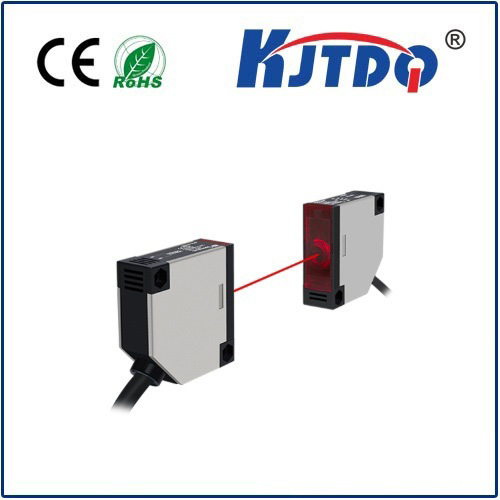
Finally, the 103 series photoelectric switches are commonly through-beam sensors. This type consists of two separate units: an emitter and a receiver. The emitter projects a continuous or modulated light beam to the receiver. An object is detected when it interrupts this beam. The 103 series is renowned for offering the longest and most reliable sensing distance among the standard types. It is highly immune to environmental factors like target color, reflectivity, or surface finish. These switches are the go-to solution for high-precision applications, such as detecting small components, ensuring safety in hazardous areas with light curtains (a specialized array of through-beam sensors), or in high-speed counting tasks where accuracy is paramount.
When integrating any of these photoelectric switches—KS9, KSE9, 59, 98a, or 103—into a system, several practical considerations are universal. First, the operating voltage (commonly 10-30V DC or 90-250V AC) must match the control system's power supply. Second, the output type (PNP/NPN transistor or relay) must be compatible with the programmable logic controller (PLC) or other control device. Environmental factors such as ambient light, temperature extremes, and exposure to chemicals or vibrations should also guide the selection process. Proper alignment, especially for through-beam and retro-reflective types, is crucial for consistent operation. Regular lens cleaning to prevent dust accumulation is a simple yet vital maintenance step that ensures long-term sensor reliability.
In conclusion, the KS9 and KSE9 offer general robustness, the model 59 provides long-range convenience with a reflector, the 98a excels in close-range, direct reflection tasks, and the 103 series delivers maximum precision and range with a through-beam setup. By carefully matching the inherent strengths of each photoelectric switch model—considering the sensing mode, range, environmental needs, and electrical specifications—engineers and technicians can significantly enhance the efficiency, safety, and reliability of automated systems. Selecting the correct sensor is not merely a technical detail but a foundational decision for optimal operational performance.