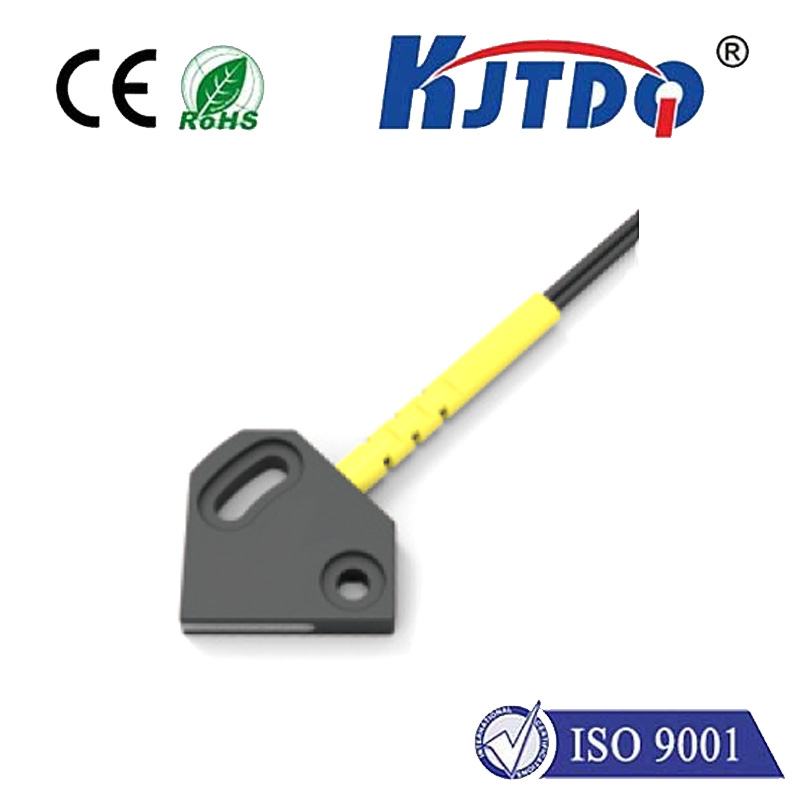
optical flag sensor
- time:2025-08-14 17:14:10
- Click:0
Optical Flag Sensors: The Precision Eyes of Modern Automation
Ever wonder how complex machinery “knows” precisely where components are on a high-speed assembly line? Or how intricate robotic arms repeat movements with unerring accuracy? Often, the unsung heroes enabling this precision are optical flag sensors. These compact, powerful devices provide crucial position feedback, triggering actions at the exact right moment, silently driving efficiency and reliability across countless automated systems. Let’s delve into how they work and why they’re indispensable.
Demystifying the Core Principle: Light Interruption
At their essence, optical flag sensors operate on a beautifully simple concept: interrupt a light beam to signal presence or position. They primarily function using infrared (IR) light, invisible to the human eye but perfect for reliable sensing. Here’s the breakdown:
- The Emitter: One side of the sensor houses an infrared light-emitting diode (IR LED). This constantly projects a focused beam of IR light.
- The Detector: Opposite the emitter sits a phototransistor or photodiode. This specialized component is designed to detect the intensity of the incoming IR light.
- The “Flag”: This is the moving target – typically a piece of plastic, metal, or even part of the machine itself. When this flag moves into the gap between the emitter and detector…
- The Interruption (and Signal): …it blocks the IR beam. The detector instantly senses this dramatic drop in received light intensity. This change triggers the sensor’s internal electronics to switch its output state (e.g., from “OFF” to “ON” or vice-versa). This clean, digital signal is then sent to the control system (like a PLC), informing it that the flag has reached the precise sensing position.
Key Components and Variations
Most optical flag sensors fall into two main categories, defined by their physical configuration:
Slotted Optical Sensors (Through-Beam): This is the most common and often the most reliable type for flag sensing. The emitter and detector are housed in a single U-shaped unit, facing each other across a precise gap. The flag physically moves through this slot to interrupt the beam. Advantages include excellent signal integrity, resistance to ambient light interference (the slot shields the detector), and high positional accuracy. They are the workhorses for detecting flags on moving carriages, rotary encoders, and position verification.
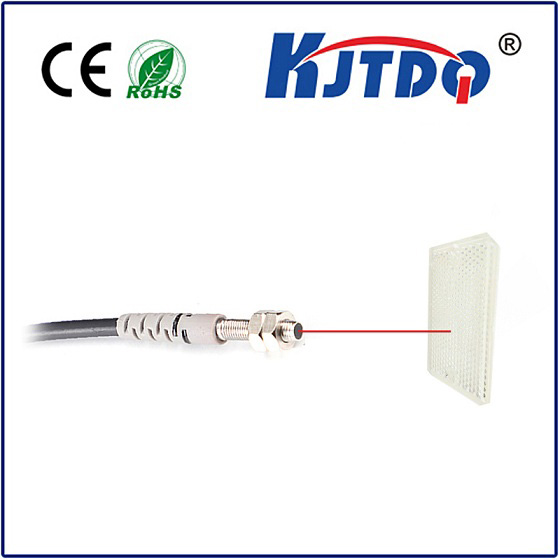
Reflective Optical Sensors: In this configuration, the emitter and detector sit side-by-side, facing the same direction. They detect the flag when it comes close enough to reflect the IR beam back to the detector. While useful when mounting space is limited on one side, they can be more susceptible to variations in the flag’s surface (reflectivity, color) and ambient light compared to slotted types. They are less common specifically for “flag” applications where a slotted sensor fits.
Why Choose Optical Flag Sensors? The Compelling Advantages
Optical flag sensors offer distinct benefits that make them ideal for demanding industrial environments:
- *Non-Contact Detection*: This is arguably their biggest advantage. Because they rely solely on the light beam, there is zero physical wear between the sensor and the moving flag. This translates to vastly increased lifespan and consistent performance over mechanical limit switches that physically make contact.
- High Speed & Repeatability: Optical sensors respond incredibly quickly to beam interruption – often in microseconds. This allows them to detect flags moving at very high speeds and provide ultra-precise, repeatable position feedback cycle after cycle.
- Long Operational Life: The lack of physical contact and the robustness of modern IR LEDs and photodetectors mean these sensors are built for endurance, requiring minimal maintenance.
- Clean, Debounce-Free Signals: Unlike mechanical switches which can suffer from contact bounce (multiple false signals on actuation), optical sensors provide a clean, crisp digital output the moment the beam is blocked. This simplifies control logic.
- Compact Size & Versatility: Available in incredibly small packages, they fit into tight spaces on modern machinery. They can detect a wide variety of flag materials (plastic, metal, etc.), provided the flag is opaque enough to reliably block the IR beam.
Where Optical Flag Sensors Shine: Key Applications
Their unique blend of precision, speed, and reliability makes optical flag sensors ubiquitous:
- Position Verification: Confirming a slide, carriage, or robot arm has reached its exact programmed endpoint.
- End-of-Travel Limits: Safely and reliably signaling when a moving part has reached its maximum safe travel range.
- Rotary Encoder Indexing: Providing a precise “home” or reference point (“index pulse”) for rotary encoders on motor shafts, vital for accurate angular positioning.
- Counting & Registration: Tracking the passage of items on a conveyor or detecting specific features on a rotating part (e.g., notches, tabs) for synchronized operations.
- Automatic Door Safety: Detecting obstructions in door closing paths in elevators, trains, and automated industrial doors.
- Printing & Packaging Machinery: Ensuring precise registration of paper, film, or labels during high-speed processes. Detecting the presence/position of cartons or boxes.
- Medical Devices & Diagnostics: Providing critical position feedback in automated analyzers and precision medical equipment.
Choosing the Right Optical Flag Sensor: Key Considerations
Selecting the optimal sensor involves several factors:
- Mechanical Fit: Crucially, does the application allow for a U-shaped slot (slotted type) or require a one-sided mount (reflective)? Slotted is generally preferred for flags due to its robustness.
- Slot Size / Sensing Distance: Match the sensor’s gap width (slotted) or sensing range (reflective) to the flag’s size and travel.
- Output Type: Common outputs include NPN, PNP (transistor switching), or digital logic levels (TTL). Ensure compatibility with the control system’s input requirements.
- Environmental Factors: Consider potential exposure to dust, moisture, oil, or chemicals. Choose sensors with appropriate IP ratings (Ingress Protection) for the operating environment.
- Electrical Requirements: Verify voltage supply compatibility and current consumption.
The Indispensable Component for Precision Control
From the humblest piece of machinery to the most sophisticated robotic cell, optical flag sensors provide the critical, non-contact position detection that automation relies on. Their simple principle of light interruption delivers unmatched speed, reliability, and longevity. Understanding their function and selecting the right type empowers engineers to build more efficient, accurate, and dependable automated systems. They truly are the precise, silent eyes monitoring position and triggering actions, forming the bedrock of modern control logic.