check

check

check

check

check

check
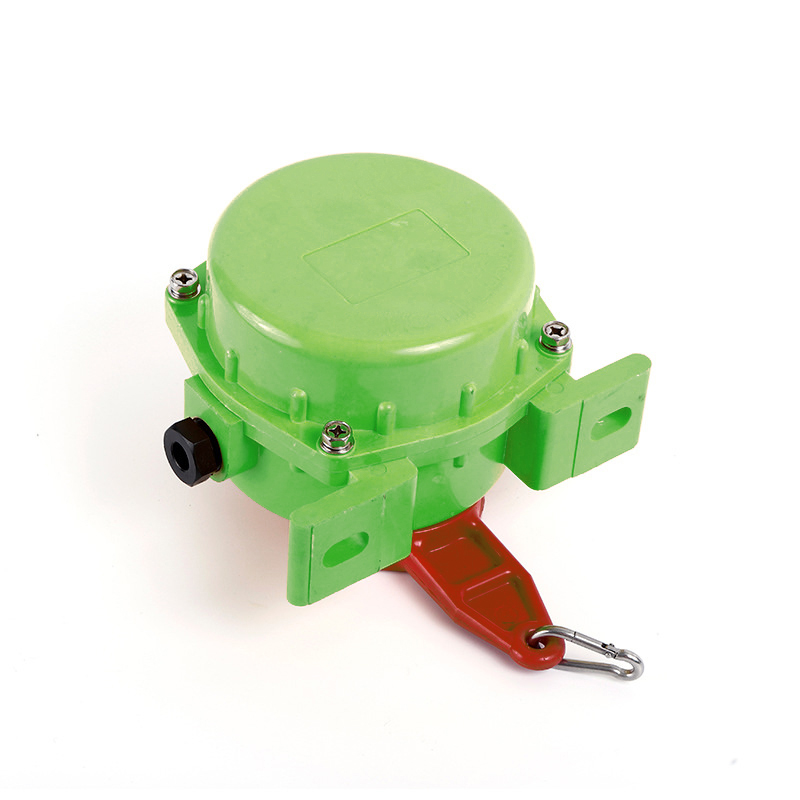
In the demanding world of industrial automation and material handling, safety and operational continuity are paramount. The sudden, unplanned stoppage of a conveyor belt or processing line can lead to significant production losses, safety hazards, and equipment damage. This is where the critical role of emergency stop devices comes into sharp focus. Among these, the pull cord switch stands as a vital, last-line-of-defense safety component. The KJTDQ KBLS2-2.5/220-T-TH/C24 model exemplifies the advanced engineering required for modern, robust industrial applications.
A pull cord switch is a manually operated emergency stop device installed along the length of a conveyor or similar machinery. In the event of an emergency—such as a worker becoming entangled, a material spill, or a visible equipment fault—any person along the line can quickly pull the cord. This immediate action triggers the switch to cut power to the drive motor, bringing the machinery to a controlled but rapid halt, thereby preventing injury or further damage. The effectiveness of this system hinges entirely on the switch's reliability, durability, and precise operation under harsh conditions.
The KJTDQ KBLS2-2.5/220-T-TH/C24 is engineered to meet these rigorous demands. The designation itself reveals key specifications. The "KBLS2" series indicates a heavy-duty, two-position switch design. The "2.5" often refers to the operating force or a specific mechanical rating. The voltage rating "220" signifies compatibility with standard 220V AC industrial control circuits, a common global standard. Perhaps most telling are the environmental ratings "T" and "TH". These typically denote special coatings or construction materials—such as thermoplastic or treated housings—that provide enhanced protection. The "T" rating often indicates suitability for temperate climates, while "TH" suggests additional protection against humidity, moisture, and potentially corrosive atmospheres. This makes the switch ideal for environments like mining, grain handling, cement plants, or outdoor applications where dust, moisture, and temperature fluctuations are constant challenges. The "C24" suffix may refer to a specific mounting configuration, contact arrangement (like 2NO/2NC contacts for flexible integration into safety circuits), or a particular certification standard.
What sets a high-quality switch like this apart is its construction and features. The housing is typically made from robust, corrosion-resistant materials like die-cast aluminum or reinforced polyamide, ensuring impact resistance and longevity. The internal mechanism is designed for positive, reliable actuation with a clear, audible snap action, providing tactile and auditory confirmation that the safety circuit has been engaged. The switch is designed for easy reset—usually a simple twist or pull—after the emergency has been resolved, allowing for quick restart of operations without the need for tools. Many advanced models also include a dual-channel safety output, which is crucial for connecting to modern Safety PLCs (Programmable Logic Controllers) to form a Category 3 or 4 safety circuit as per ISO 13849-1, ensuring a high level of performance and diagnostic coverage.
Installation and maintenance are straightforward but critical. The switches must be positioned at accessible intervals along the conveyor (typically every 20-30 meters) and at key hazard points. The pull cord should run parallel to the conveyor at a safe and reachable height. Regular testing, as part of a facility's safety protocol, is non-negotiable. This involves manually pulling the cord to verify it cleanly breaks the control circuit and stops the machinery. The robust design of the KBLS2-2.5/220-T-TH/C24 minimizes maintenance needs, but periodic inspection for cord tension, housing integrity, and contact cleanliness is essential for guaranteed performance.
For system integrators, plant managers, and safety engineers, selecting the right pull cord switch is a decision with direct consequences for personnel safety and plant uptime. Choosing a proven model like the KJTDQ KBLS2-2.5/220-T-TH/C24 means investing in a component built to withstand industrial punishment while providing fail-safe operation. It integrates seamlessly into broader emergency stop and safety interlock systems, forming a reliable network of protection that guards both human operators and valuable capital equipment. In essence, it transforms a simple pull into a powerful, life-saving command, embodying the principle that the simplest safety solutions are often the most critical.